Carrier Appetite Signals That Tell You Which Inland Marine Desks Understand Autonomous Robot Deployments
Quote questions and policy wording show which desks truly understand robots.
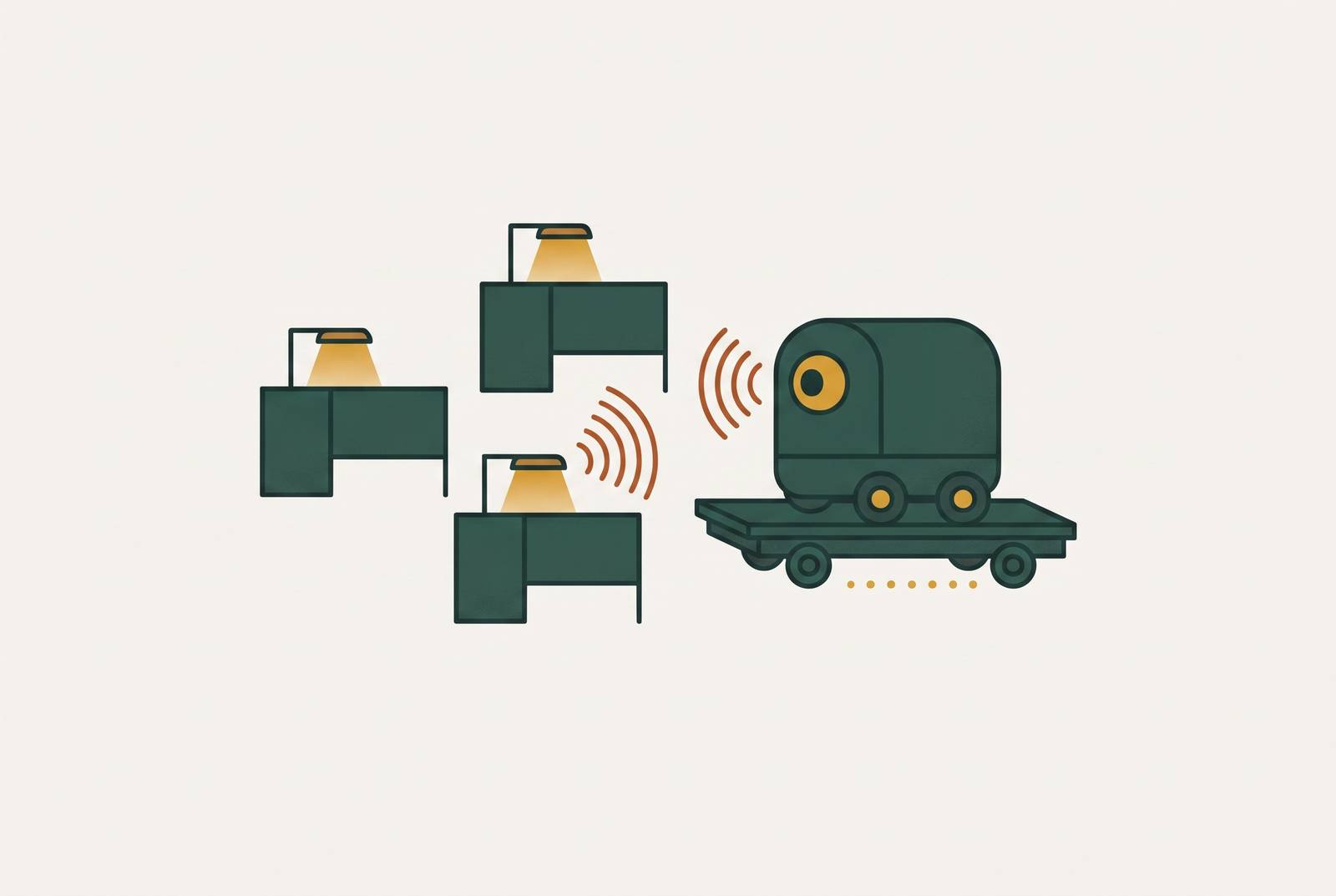
Inland marine coverage for deployed robot fleets can follow movable hardware between job sites and across operating locations, but on its own it does not cover all autonomy-specific losses. A capable desk shows what it understands through the underwriting questions it asks, the liability assumptions it makes, and the wording of its policy. Reading those signals before binding separates coverage built for autonomous operations from a conventional equipment policy that may exclude the deployment’s central risks.
Why inland marine coverage for deployed robot fleets was not designed for autonomy
Traditional inland marine underwriting uses historical loss runs, equipment records, and operating controls to price movable equipment. Its logic starts with passive equipment, while autonomous machines make real-time navigation and perception decisions. That distinction changes the underwriting task. The evidence used to assess conventional equipment does not exist at scale for autonomous agents, so hardware value and operating location cannot describe the whole exposure.
An AI perception failure causes bodily injury, a cyberattack hijacks physical controls, or a software update takes an entire fleet offline. The last scenario need not involve physical damage. No single legacy line is designed to absorb all three, and apparently comprehensive inland marine coverage may respond to none of them. Because the mismatch is structural, it appears in a carrier’s appetite signals before a policy is bound.
What carrier appetite actually means and where to find it
A carrier’s appetite is the risk it is equipped and willing to accept, expressed through the questions it asks, the information it requires, and the exclusions it uses. A brochure cannot establish that willingness on its own. Questions about autonomous decisions and human intervention indicate a different underwriting exercise from questions limited to replacement cost and storage. Omissions are evidence too, because a desk that never asks how autonomy works has not distinguished the robot from conventional equipment.
A pricing declination indicates a different decision from a rejection because the deployment is “outside appetite”. The former can reflect an understood risk that the desk elects not to price, while the latter indicates that the deployment falls beyond the program it accepts. Quote wording provides the next test. Exclusions added or removed reveal where the carrier is prepared to respond, regardless of how receptive the initial conversation sounded.
These signals work best when read together. A detailed questionnaire followed by a blanket autonomous-operations exclusion presents a different proposition from a quote that expressly addresses autonomous losses. Conversely, a simple intake process is not evidence of expertise merely because the desk produces a quote quickly. A desk without an autonomous-robot program defaults to generic inland marine forms, and those forms begin with passive equipment.
The underwriting questions a prepared desk asks that an unprepared one skips
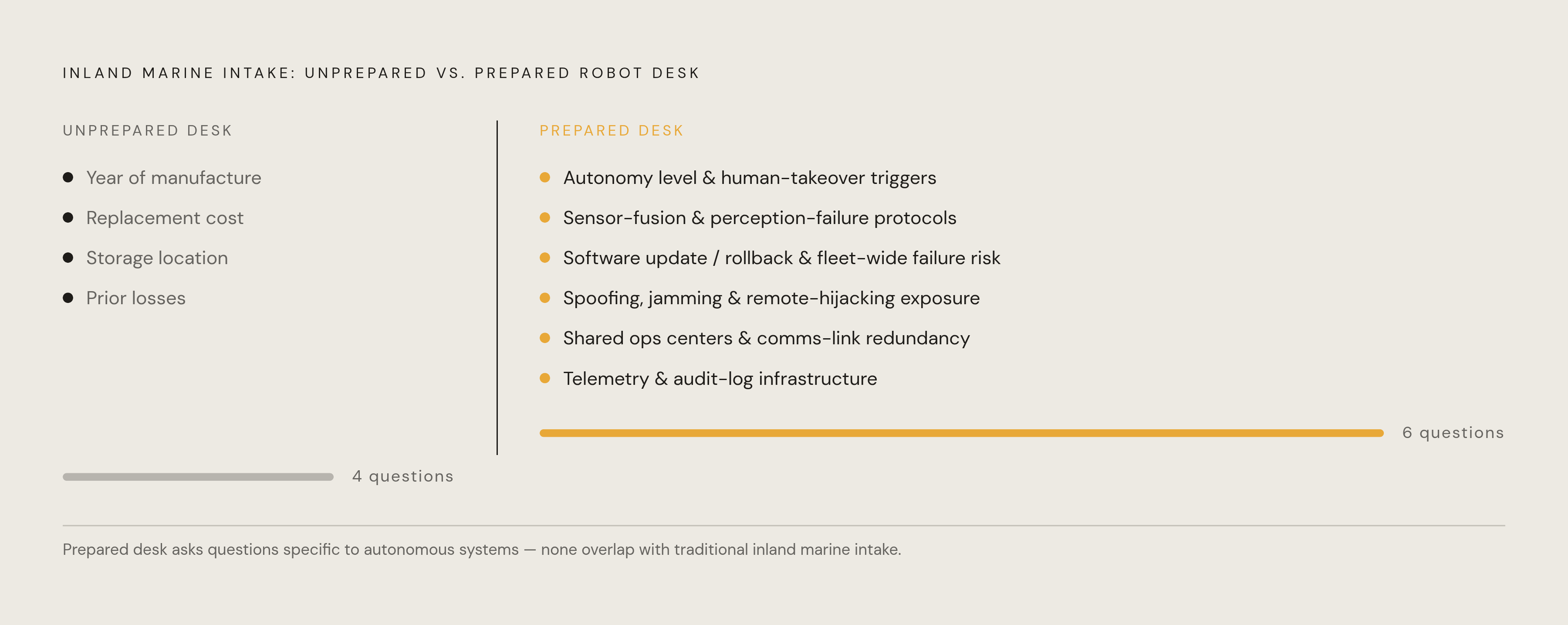
A prepared desk asks whether the robot runs fully autonomously, semi-autonomously, or under remote supervision, and when a human takes control. An unprepared desk starts and ends with the year of manufacture, replacement cost, storage location, and prior losses. Those equipment facts remain relevant to the hardware. They do not explain its decision architecture. The distinction is whether the underwriter investigates how the asset operates, rather than treating it as a forklift with a different description.
The desk also looks into sensor-fusion and perception-failure protocols. A prepared desk asks what happens when sensors disagree or return ambiguous data, then asks whether continuous telemetry and automated intervention records can establish causation after an incident. Records serve a different purpose from equipment inventories. They help distinguish a system failure from a human intervention decision, rather than simply establishing what the insured owned. A questionnaire confined to prior losses never reaches that distinction.
Software questions provide an equally concrete comparison. A prepared desk asks how updates are tested, deployed, and rolled back, including whether one bad update could take the entire fleet offline. It also asks about spoofing, jamming, and remote hijacking of physical controls. Shared dependencies receive their own scrutiny. Common operations centers, software versions, and communication infrastructure create accumulation exposure that separate replacement values do not describe.
How policy language reveals whether a desk has thought through autonomy-specific losses
The quoted policy turns the underwriting conversation into coverage terms. Its exclusions and triggers show which parts of the deployment the carrier has accepted and which it has left outside the contract. The transition from questions to wording is decisive. A desk may ask detailed technical questions and still offer a form that excludes the operating condition it asked about.
A blanket AI or autonomous-operations exclusion removes coverage for the way the insured asset is built to work. A cyber exclusion can leave a gap just as large if it excludes physical damage caused by hijacking or spoofing. The exclusion’s reach is the critical point. The buyer needs to check both whether the policy has cyber language and whether that language excludes a physical-damage event that arises through the robot’s controls. An AI exclusion tracker can help identify exclusion filings for review, but the quoted wording determines the coverage being offered.
Affirmative language provides the contrasting signal. A prepared program expressly addresses bodily injury and property damage arising from AI navigation or perception failures, and physical damage resulting from a cyberattack taking control of a robot. Non-physical loss needs its own coverage trigger. A sensor failure or software update can halt production without damaging property, leaving a standard physical-damage trigger unmet. The buyer must check how coverage works across the program, even if the inland marine label sounds broad enough to cover every consequence.
Why the remote-operations architecture is the underwriting question most desks miss
The remote-control link is both an operational dependency and a route through which physical controls can be compromised. That dual role makes it the most revealing diagnostic question a buyer can put to a desk. Equipment value alone cannot describe this exposure. A desk that does not investigate the link has left part of the accepted risk unexamined, even if it has collected extensive hardware records. Its answer shows whether the program was built for autonomous operations or made by adapting conventional forms.
A prepared desk examines communication-link redundancy and asks how the robot behaves when the link degrades or fails entirely. It also examines fail-safe design, distinguishing a system that defaults to a safe state from one that continues on last-known instructions. These underwriting distinctions describe the relationship between loss of contact and continued physical operation. A generic question about whether remote supervision exists does not establish either answer.
Shared infrastructure then changes the scale of the possible loss. Many robots may depend on a common operations center, software version, or communication infrastructure, allowing one exploit or failure to take the fleet offline simultaneously and creating accumulation exposure. IUMI’s March 2026 analysis of autonomous inland waterway operations raises the same question about whether remote operation increases cyber aggregation risk. The comparison shows that underwriters face this question across autonomous systems, while allowing for differences in the exposures of vessels and land-based robots.
What the absence of a regulatory framework means for how carriers price the unknown
Underwriters make liability assumptions where regulators and courts have not settled responsibility. Carriers that are willing to consider the same robot deployment can offer sharply different quotes because they make different assumptions. A desk must still decide how it views the respective roles of the hardware maker, software developer, and operator when an autonomous robot causes harm. Those roles cannot be taken for granted when there is no standard contractual risk-allocation model for the parties in multi-party robot deployment chains.
Remote operation adds another unresolved question about who is legally operating the machine. IUMI asks, “Who is legally navigating when the vessel is controlled from a Shore Control Centre?” The question concerns vessels, but it illustrates how moving control away from the physical asset leaves responsibility for harm unresolved. Causation creates a further distinction. An incident involving both system failure and a human intervention decision requires an account of how those contributions are separated. The desk’s assumptions affect how it understands the submission before it offers terms.
For buyers, the practical response is to ask the carrier directly what liability-allocation assumption it uses. A prepared desk can explain the assumption documented in its program guidelines, even where the law remains unresolved. A vague answer is a negative signal. “Case-by-case” treatment without an articulated assumption or a specialist at the desk does not explain how the risk was priced. Regulatory uncertainty makes this question more useful because it exposes the reasoning behind otherwise difficult-to-compare offers.
How submission quality determines which appetite signals you even get to see
The usefulness of a carrier’s response depends on the submission that prompted it. A generic equipment submission routes to a generic desk, while a specialist submission reaches the carriers that have built programs for autonomous deployments. The buyer’s leverage begins before the quote. A submission that describes only asset values and locations cannot reveal how a specialist would assess the actual operating architecture. It may lead the desk to add exclusions for risks it cannot assess.
A submission built for autonomy describes the level of autonomy, human-supervision model, and fail-safe behavior. It documents telemetry and audit-log infrastructure sufficient to establish causation after an incident. Deterministic safeguards deserve explicit documentation as well. They provide evidence that runaway execution cycles are architecturally prevented. Together, these details give the underwriter a basis for assessing the controls behind the deployment rather than relying on a general claim that the robots operate safely.
The submission also explains software deployment and rollback processes and discloses shared operations centers, common software versions, and communication infrastructure. Those disclosures make correlated loss visible before pricing. A complete submission also tells the underwriter how the buyer manages risk, which affects both the price and whether the underwriter is willing to offer capacity. The reverse is equally true. A poorly assembled submission can suggest weak risk management and leave the desk unable to evaluate the exposure on its merits, resulting in a decline or exclusions broad enough to protect against what remains unknown.
The practical checklist for evaluating an inland marine desk before you bind
Before binding, the buyer should evaluate the desk against its intake, technical reasoning, liability assumptions, and quoted coverage response. The intake should ask about autonomy level, remote-operations architecture, telemetry, software update discipline, and the cyber-physical attack surface. Equipment questions alone are not enough. The desk should also look at how shared operations centers, software, and communication links can lead to accumulation. A questionnaire that omits those dependencies leaves the fleet-wide exposure outside the underwriting discussion.
The buyer should then ask the desk to explain its liability-allocation assumption and how the policy responds to concrete loss scenarios. These scenarios include bodily injury from a perception failure, cyber-caused physical damage, and production loss from a non-physical failure. Each tests a different coverage boundary. The wording should address those events without a blanket AI or autonomous-operations exclusion, and the desk should be able to explain the response to a fleet-wide software failure with no physical damage. Deferring responsibility to “whatever the courts decide” does not supply an underwriting assumption.
If the desk declines, the buyer should distinguish a pricing decision from an “outside appetite” response. Placement experience can shorten this process. A specialist broker who has placed autonomous robot risks and reads every policy before binding can use that placement experience to route the submission to an equipped desk. Even when the hardware appears on an inland marine schedule, the binding decision should rest on what the contract does when autonomy fails.