Inland Marine as the Fleet-Level Framework for Multi-Site Mobile Robot Operations
Inland marine protects robot fleets across job sites and transit routes.
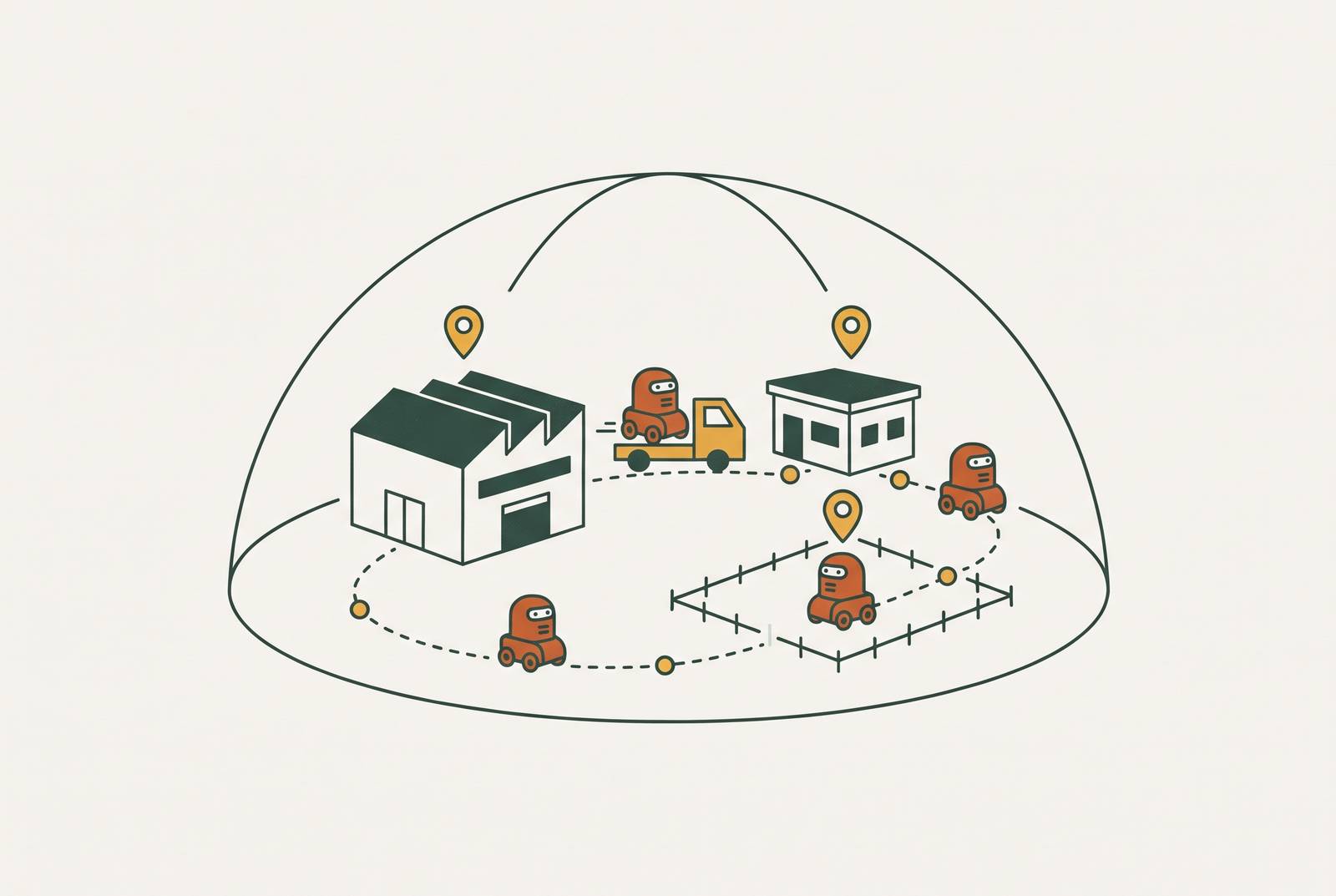
Inland marine coverage for deployed robot fleets is the property insurance layer designed to follow hardware between job sites, through transit, and into customer locations. For multi-site mobile robot operations, the central decision is how to match that protection to the fleet’s deployment cycle, asset values, and growth through scheduled or blanket floater coverage.
Why standard commercial property insurance leaves mobile robot fleets exposed
A robot is damaged in an accident during transport between customer sites. The operator files a claim under its standard commercial property policy, but the insurer declines because the damage occurred outside the covered location. The denial follows the policy’s basic design. Standard commercial property insurance covers property at the premises named in the policy, and that protection usually ends or becomes very limited when equipment leaves those premises.
A deployed robot may be working at a customer’s warehouse, a construction site, a public road, or a remote facility rather than at the operator’s principal business location.
Equipment temporarily stored at a client’s location or undergoing installation or servicing can also fall outside a standard property form. These are routine stages of deployment. For an operator relying only on protection at its own address, the gap can persist throughout a customer assignment. A larger insured value at headquarters does not resolve a mismatch between the policy’s covered location and the robot’s actual location.
What insurance covers autonomous robots traveling between job sites?
Inland marine grew out of ocean marine cargo protection when insurers began to cover goods moving over land as rail transport grew during the Industrial Revolution. It emerged as a distinct category in the early 20th century. Its organizing principle is straightforward. The property, rather than the business premises, is the reference point for coverage.
That principle explains the term floater. Inland marine can protect movable equipment while it travels, sits at customer locations, or remains in temporary storage instead of restricting protection to a fixed business address. Common covered perils include transport collisions or accidents, theft, mishandling, fire, and storm damage. Those exposures apply directly to a robot being trucked between assignments or held at a customer facility.
The structural fit does not make every floater interchangeable. The policy still needs to fit the property, where it goes, who has custody of it, and what happens during deployment. A robot’s ability to travel is only one part of that description. Installation, field servicing, and operation at other businesses’ premises determine where protection must extend.
The three specific exposures inland marine resolves for a multi-site robot deployment
The first exposure begins when a robot leaves the depot. During the truck journey, collision, overturning, or handling damage can impair the asset before it reaches the customer. Standard premises coverage may no longer apply. Inland marine in-transit protection addresses physical loss or damage during transportation, making the journey between locations part of the coverage design.
The robot may be stored temporarily before being delivered into position, tested, and commissioned at the customer’s site. A standard property form may leave both the customer address and the move into operational service without coverage. An appropriately structured floater can cover the temporary location and bridge installation and commissioning.
Once commissioned, the robot operates away from its owner’s premises, sometimes in the care, custody, and control of a customer, subcontractor, or field service partner. With a premises-bound policy, it can be unclear whether equipment is covered while another party holds or services it. Inland marine can explicitly address that arrangement as well as the off-premises location, rather than assuming that arrival at the customer transfers responsibility for every physical loss.
The robot faces those exposures again on the journey back. A company operating across a dozen customer sites can have robots in transit, awaiting commissioning, operating, and undergoing service at the same time. The three core exposures are transit, temporary location, and third-party custody, with installation and commissioning spanning the transition into use.
How scheduled and blanket floater forms map onto different fleet structures
For operators choosing a form, the practical distinction is how equipment enters coverage and how its value is represented. A scheduled floater lists each asset with a stated value or per-item limit. It suits a small fleet of high-value, individually distinct robots that can be tracked by serial number. Precision is its principal advantage. However, an individual listing does not itself establish agreed-value settlement, since scheduled equipment may be insured on an actual cash value or replacement cost basis.
A blanket floater instead has an aggregate limit for the covered equipment, with no need to list each item. That structure suits larger fleets whose unit counts change frequently or whose robots are functionally interchangeable. The operator must keep the available limit in line with the total value of the equipment as the fleet grows, rather than rely on a list of individual assets that stays the same.
Consider a company deploying five robots in Q1 and twelve in Q3. Under a scheduled structure requiring each asset to be listed, the additional Q3 units remain uninsured until the schedule is updated. Under a blanket structure, new equipment that meets the policy terms is covered automatically, within the aggregate limit. A new deployment should not depend on an asset update that the insurance administration has yet to complete.
Blanket protection does not remove the need to assess value. If a small fleet contains very expensive robots, a single total loss can consume the available aggregate limit and leave insufficient protection for other deployed assets, depending on the policy’s limit structure. For companies moving from pilot deployments to commercial scale, blanket coverage typically reduces administrative burden.
Why robot hardware demands specialized inland marine underwriting, not a contractor's equipment floater off the shelf
A contractor’s equipment floater provides a familiar structure for bulldozers and cranes, but autonomous hardware presents a different underwriting problem. Inland marine underwriters look at the type of property, what it is worth, where it goes, past losses, and how the operator manages risk. Robot fleets complicate each input. A generic equipment description can obscure the features that determine both the cost of restoring a damaged unit and the likelihood of a loss.
Valuation starts with more than the hardware purchase price. Proprietary sensors, embedded firmware, trained models, and integration work contribute to the cost of returning a robot to operational status. The discussion of valuation and coverage needs to spell out how each of those components is treated. An understated asset value can produce a payment that does not fund restoration of the working unit. Conversely, assigning a value to software-dependent components does not by itself establish how the policy will respond to their loss.
Sensor degradation, software update failures, and model drift can cause physical damage to the robot or its surroundings. These mechanisms raise liability concerns and affect the probability and character of a hardware claim, although identifying a failure mode does not establish that every resulting loss is covered. Unfamiliarity with those mechanisms can lead an underwriter to price uncertainty.
Geographic scope adds another distinction. A locally deployed fleet presents a different underwriting picture from one operating across multiple states or international borders, while a submission stating only “nationwide” leaves that picture indistinct. Operational zones and technical detail make the risk more legible. The appropriate form therefore needs tailoring to robot operations.
Where inland marine ends and the rest of the coverage stack begins
Inland marine addresses physical loss or damage to the robot itself. It does not replace insurance for injury to people or damage to someone else’s property caused by the robot. Those exposures belong in commercial general liability, or CGL. Similarly, financial harm from a software or model failure that causes no physical damage belongs in technology errors and omissions, or tech E&O. Network compromise and malicious control of the robot belong in the cyber layer.
A single malfunction can cross those boundaries. The robot may be physically damaged while also causing third-party damage, injury, or loss tied to a software failure or cyber event. Different parts of the loss can therefore point to different policies. The complication is not simply the number of policies involved, but the possibility that their terms point elsewhere for primary coverage.
ISO form CG 35 08 01 26 applies to the Products/Completed Operations Liability Coverage Part and excludes bodily injury and property damage arising out of generative artificial intelligence. It is not a blanket exclusion for autonomous systems. Nor does it apply to the main CGL Coverage A merely by virtue of that form designation. Treating it as a universal robotics exclusion would misstate both its scope and its placement.
For an operator whose liability coverage contains a relevant AI exclusion, the response belongs in the liability placement. An affirmative endorsement or standalone product may be needed to restore the protection removed by that exclusion. Inland marine cannot repair that gap. Its role remains physical asset protection while the other layers address the distinct consequences of operating the asset.
What a well-structured inland marine submission looks like for a robot fleet
To translate this framework into a placement, an operator should present a coherent account of property value, geographic scope, loss history, and risk management. The asset information should identify each robot by serial number, current replacement value, and operational status, with hardware, sensors, and integration reflected in the valuation. A lump-sum “robot fleet” figure obscures those distinctions. The submission should also recommend scheduled or blanket coverage explicitly, based on the fleet’s composition and deployment growth.
The site information should identify every customer location and describe whether the assignment is a permanent installation, rotating deployment, or temporary pilot. That gives the underwriter a basis for assessing location and custody exposure. Movement needs its own description. The transit profile should explain whether robots travel in company-owned vehicles, through third-party carriers, or through customer logistics, along with the packaging standards used and how often the robots move. Those details directly inform the in-transit component of the risk.
Safety and maintenance records should make the operator’s controls visible. Maintenance schedules, inspection records, and incident history provide evidence beyond a general claim that the fleet is well managed. Telemetry documentation should describe whether real-time remote monitoring exists, what data is logged, and how long logs are retained. Demonstrable risk management gives the underwriter a stronger basis for terms than an unsupported equipment description.
A specialist broker who understands both inland marine forms and robot technology can build the submission around these actual exposures. The broker’s commission is usually included in the premium, though some complex placements come with an extra advisory fee that is disclosed. The submission should make the required continuity explicit. Protection needs to extend through transit, customer custody, commissioning, operation, and return, with asset values and the chosen floater structure keeping pace as the fleet changes.