The Commercial Policy Stack That Covers Robot Fleets From Loading Dock to Deployment Site
Robots need layered coverage that follows them through transit, storage, and operation.
Inland marine coverage for deployed robot fleets follows hardware in transit, at customer sites, on pilots, and at demos. It does not take the place of liability insurance for autonomous operations. Covering a fleet from loading dock to deployment site requires a deliberate stack of equipment, general liability, technology E&O, cyber, and excess coverage, with policy language that closes the gaps between them.
Why a robot fleet's journey from loading dock to deployment site is not a single insurable event
A fleet of autonomous mobile robots is being loaded onto a truck for its first customer deployment. Before any robot begins work, the equipment passes through loading and staging, transit, and temporary storage at the customer site. Live operation adds a fourth risk environment. Each phase in that sequence changes the assets exposed, the parties potentially liable, and the policy language that governs a loss.
Embedded software makes that sequence different from moving conventional equipment because it can continue making decisions throughout the journey. A navigation error during a customer-site demo is not a shipping loss, even when the same machine is involved. Standard commercial insurance separates exposures around assumptions about fixed premises, licensed drivers, and human acts or omissions. Autonomous hardware crosses those boundaries as it moves between facilities, so coverage must follow both the equipment and the changing nature of its use.
What insurance covers autonomous robots traveling between job sites?
Inland marine insurance, written as equipment coverage, addresses the basic property problem for mobile robot fleets. Standard commercial property coverage centers on assets at a scheduled location, while inland marine follows equipment away from the company's premises. The name comes from cargo insurance. Its modern role includes hardware in transit, at customer sites, on pilots, and at demos.
Transit exposes the limits of relying on property and auto policies together. Robots on a flatbed are outside the location covered by a standard property form, but they are cargo rather than the vehicle insured under commercial auto. Neither policy automatically fills the other's gap. The fleet's value therefore needs equipment coverage that follows it between locations, rather than an assumption that the truck's insurance also protects everything loaded onto it.
Arrival does not end the property exposure. Robots may remain at a customer site for days before a pilot begins, while the customer's property policy does not extend to vendor equipment. The vendor's own policy may provide some off-premises protection, but a low sublimit can leave much of the fleet's value exposed. A form that reaches the site is insufficient if its limit cannot cover the equipment stored there.
How general liability coverage is structured for robot operations and where it stops
Commercial general liability responds to bodily injury and damage to third-party property. Those are direct exposures for machines working around people and infrastructure. Site owners therefore typically demand proof of coverage before activation. They also often ask for additional-insured status under the operator's policy. Site access therefore depends on more than insuring the robots themselves.
Autonomous operation complicates that division because physical harm can originate in a software decision. A standard CGL form may contain technology or professional-services exclusions that complicate the claim even though its outcome is bodily injury or property damage. A purpose-built program needs language addressing autonomous operations. Otherwise, a policy obtained to satisfy site-access requirements may still leave the fleet's characteristic failure mode unresolved.
The seam between general liability and tech E&O, and why autonomous systems fall through it
Consider a faulty sensor update that halts a warehouse line without damaging equipment or injuring anyone. Technology errors and omissions coverage covers money lost because of software errors, failures, or omissions. That makes it a distinct layer. CGL's focus on bodily injury and third-party property damage does not answer every loss arising from a robot's work.
Now consider a software decision that does cause physical damage. Standard tech E&O forms exclude bodily injury and property damage, while CGL and products liability can have technology or professional-services exclusions. One line may exclude the physical outcome, while the other disputes coverage because of the software or service that produced it.
This is the CGL/E&O seam that requires deliberate drafting. Buying both lines does not, by itself, make their boundaries meet. The stack described here includes tech E&O scoped to cover software-driven physical harm, together with CGL language addressing autonomous operations. Those provisions connect the software exposure to its real-world consequences. Without that connection, the operator can hold two apparently relevant policies while retaining the loss neither was written to accept.
Cyber coverage as a robot fleet layer, and the double exclusion that leaves operators exposed
Consider a fleet of autonomous mobile robots whose navigation software is poisoned, causing simultaneous stoppages across three customer sites. This is an illustrative accumulation event. A vulnerability in software that all the units share can stop every unit at once. Unlike fire or flood, that concentration of risk has no geographic boundary, so distributing robots across sites does not necessarily separate their cyber exposure.
Smart factories and warehouses intensify the connection between digital compromise and physical operations. IoT sensors, AI platforms, robotic controllers, and cloud systems are tightly linked, allowing a compromised entry point to cascade through the operation. Controllers can be hijacked remotely, and AI models can be corrupted. Business interruption and third-party liability can then arise from the same event. A cyber policy written only for data breaches and IT outages does not fully describe that risk.
When a cyber event produces physical harm, standard cyber coverage may not address the physical damage, while the technology-related exclusions in liability coverage can complicate the same loss from the other direction. Neither label resolves the overlap. Robot fleet cyber coverage therefore needs an explicit scope that includes physical damage from a cyber event and the downstream business interruption it causes. That scope must fit with the liability layers so that each policy does not leave the loss to another.
The AI exclusion wave that is actively narrowing what CGL and other policies will cover
Existing boundaries are only part of the problem. AI exclusions are actively narrowing coverage that operators may assume remains available. ISO forms CG 40 47, CG 40 48, and CG 35 08 target generative AI specifically. Broader exclusions in professional liability and management liability can also apply to predictive and scoring AI, so checking the wording takes more than asking whether a fleet uses generative AI.
Some carriers have filed absolute exclusions for any loss arising from the use or development of AI, with no carve-back for physical harm. These exclusions are found mostly in management liability lines such as D&O, E&O, and fiduciary liability. Their reach differs from the ISO forms. The result is an exclusion problem spanning several policy types rather than a single endorsement that can be reviewed in isolation.
For operators, renewal is therefore a substantive coverage review. A policy bought two years ago may now have a narrower scope, and continuity cannot be assumed without reading every endorsement. The same policy name and coverage limit do not establish the same protection. As exclusions change, layers that once fit together can leave software-driven losses uncovered even though the operator still buys each familiar line.
What enterprise contracts and state laws actually require before a robot fleet can operate
Customer contracts drive most robotics insurance purchases because coverage is frequently a condition of access. Master services agreements, site access permits, and pilot addenda routinely require general liability with the site owner named as an additional insured, workers' compensation, tech E&O, cyber coverage, and umbrella limits. These requirements are rarely negotiable. They may also sit outside the main commercial terms, so an agreed pilot can still face an insurance barrier before deployment.
Legal requirements add another layer to that constraint. State insurance floors vary, while cities are beginning to require comprehensive coverage before permitting autonomous vehicle deployments. These requirements apply according to deployment category. The commercial-contract requirement is more broadly immediate for operators seeking enterprise customers. Both make insurance part of deployment readiness.
A proactively assembled stack puts the operator in a position to produce a certificate of insurance that meets the applicable customer's or regulator's conditions at the start of a pilot. Reactive placement can instead delay access or cost the operator the pilot. Insurance therefore belongs in the commercial preparation for deployment, rather than after the equipment and customer agreement are ready.
How the underwriting submission determines the coverage and the premium for a robot fleet
Underwriters have thin claims history for autonomous robot risk, and the same robot can present materially different exposures in two warehouses. They therefore rely heavily on what the submission tells them about the operating environment. A generic description leaves that difference unexplained. The result can be an overpriced generic policy or a policy priced correctly for an exposure that does not match the actual fleet.
A useful submission makes the fleet's operating conditions and controls legible to the insurer. Safety metrics, audit documentation, and clear operating limits give the underwriter evidence on which to distinguish the risk. Missing answers have commercial consequences. Manufacturers that cannot explain their exposures face tighter terms, higher retentions, and less capacity, while fleets that show they have strong controls can earn lower premiums and better terms.
That description also has to keep pace with deployment. Software versions and operating limits can change after placement, and expansion to new sites or operating modes can make the original submission inaccurate. The gap can develop between renewals. Updating the submission connects the insured description to the fleet as it now operates, rather than leaving the policy attached to an earlier version of the business.
The same evidence helps the market price safety favorably because insurers have a direct commercial incentive to distinguish better-controlled risks. Structured, verifiable operating data is more useful for that purpose than a description of what a robot is intended to do. This is where specialist brokerage earns its place. Its primary value is building an accurate submission and placing it with carriers that explicitly cover autonomous operations.
What a complete coverage stack looks like, assembled deliberately rather than by default
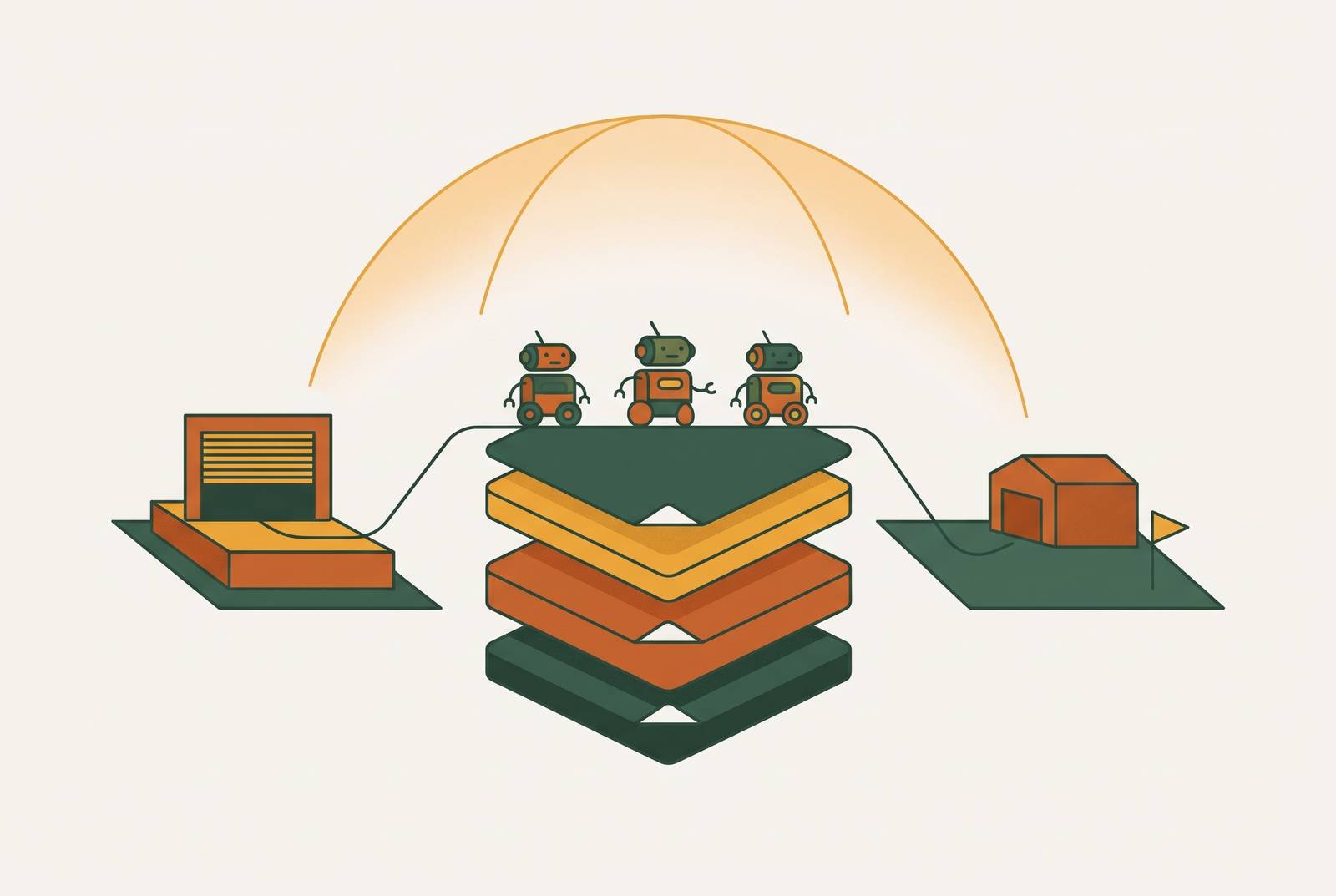
Inland marine or equipment coverage protects hardware in transit and at customer sites, while CGL with autonomous-operation language addresses site access and third-party harm. Tech E&O scoped for software-driven physical harm closes the boundary between software error and physical loss. Cyber coverage that explicitly includes physical damage and business interruption covers compromised controls, and umbrella or excess limits match the scale of deployment and the minimums set by contracts.
Venture-backed operators also need D&O coverage in that stack. Investors can sue directors personally for misrepresentation or breach of fiduciary duty, and that exposure grows with each funding round. Contractual workers' compensation requirements remain relevant as well. These obligations sit beyond the immediate question of whether a robot is protected on a truck, but they affect whether the business has assembled coverage for its full deployment and corporate exposure.
AI exclusions, evolving state laws, and new operating footprints require updated submissions and endorsement reviews at renewal. A prior-period certificate is not evidence of current coverage. The standard broker's failure mode is mismatch rather than malice, because conventional forms can misprice or misdescribe autonomous hardware until a denied claim exposes the gap. A specialist who reads every policy before binding and builds the submission from actual operating data provides the mechanism for avoiding that mismatch, with commissions already built into the premium.