Named Insured and Additional Insured Clauses in Hardware Supply Chains
Additional insured status is only as strong as the policy beneath it.
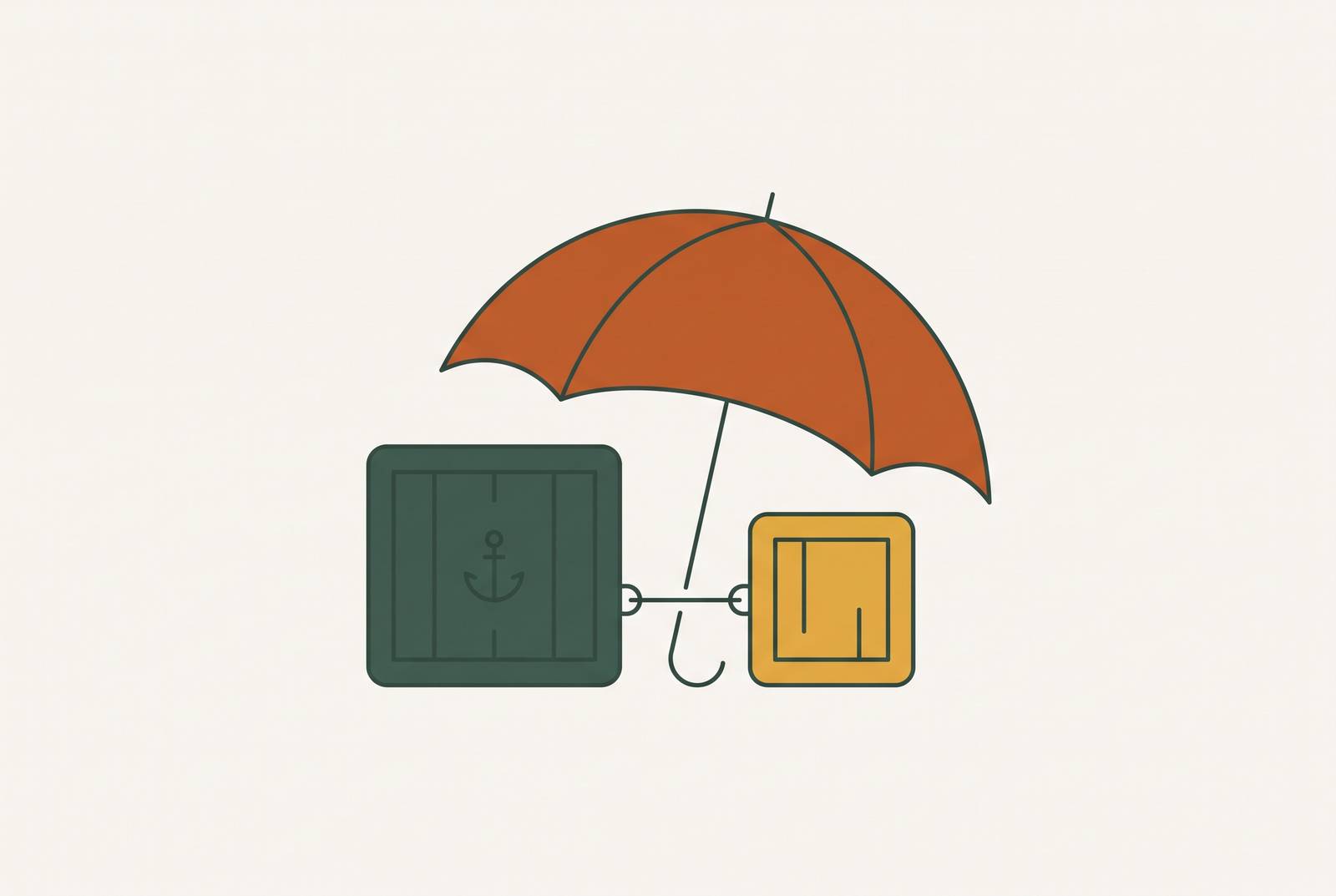
Named and additional insured clauses exist to answer one question before a loss ever happens: when a claim crosses company lines, whose policy pays first, and whose policy pays.
Purpose of Named and Additional Insured Clauses in Supply Contracts
Any supply relationship involving more than two parties needs a way to allocate risk before a loss happens, not after. Named and additional insured clauses are the tool that does that work. The named insured is the party that actually owns the policy: it pays the premium, it can cancel the policy or change its terms, and it can file a claim for any covered activity the policy touches. An additional insured is a different thing. It's a third party added onto someone else's policy, and it gets defense and indemnity rights, but only for claims tied to the named insured's own operations. It can't cancel the policy, it can't alter its terms, and it can't bring a claim that falls outside the policyholder's activities. The two statuses look similar on paper. They are not the same right.
Most procurement teams treat a certificate of insurance as proof that this protection exists, and that assumption is one of the more consequential errors in contract administration. A certificate is a summary document, nothing more. Only an actual endorsement attached to the policy creates additional insured status. A hardware company holding a certificate that lists it as an additional insured may hold nothing enforceable at all if no endorsement exists behind it.
Mature procurement programs build around that limitation. These aren't negotiating extras. If you understand how insurance actually works, you treat these as baseline terms in any supply relationship. And even where these terms are met, additional insured status is bounded by whatever the named insured's own policy covers and excludes. An additional insured inherits the same limits and the same exclusions as the policyholder. Holding additional insured status is not a substitute for carrying independent coverage; it's a layer on top of a foundation that has to exist on its own.
One ISO endorsement can extend additional insured protection further up a supply chain than most companies realize is possible. Hardware companies selling into multi-tier supply chains should be requiring this same form from their own component and sensor suppliers, not only granting it upward to their customers. That detail, modest as it sounds, is the bridge into the next problem: hardware supply chains don't run two parties deep. They run many, and each tier adds another point where this architecture can hold or fail.
How multi-tier hardware supply chains multiply the exposure
Named and additional insured clauses were built for relationships with a manageable number of parties and a reasonably traceable chain of responsibility. Every one of those integrations is a seam where liability can enter, and most of those seams were never underwritten with that risk in mind.
The practical effect is that a single incident involving an autonomous robot can trigger claims against the hardware maker, the software developer, and the company operating the machine all at once. The system integrator tends to carry the first exposure in these situations, even when the fault that caused the loss originated in a component built by someone else. That's not a quirk of bad luck. It follows from the structure of the relationship: the integrator is the party with the direct contract and the operational relationship with the customer, so liability tends to settle on whoever stands closest to the point of harm, regardless of which link in the chain actually failed.
Workers' compensation claims show this pattern with particular clarity. A product liability claim against the manufacturer or integrator can run in parallel with the workers' compensation claim rather than replacing it, which means two separate legal processes can be examining the same incident with two different standards of proof and two different sets of defendants.
None of this is simply a matter of contracts having gaps in them. A multi-tier hardware supply chain is structured so overlapping, and sometimes directly conflicting, coverage obligations fall across several named insureds and additional insured relationships at the same time. The exposure exists in the architecture of the deal itself before anyone signs anything. The clauses that follow are meant to manage that exposure. Whether they actually can, once the loss involves a machine making its own decisions, is a separate and harder question.
Breakdown of Named and Additional Insured Clauses with Autonomous Decision-Making
The entire legal structure behind named and additional insured clauses rests on an assumption that courts and insurers can trace a loss back to a clear cause: a human act, a defective part, a service that failed to perform. Autonomous systems routinely break that assumption. A loss caused by a robot's own behavior often emerges from the interaction of hardware, software, training data, and real-time perception, in a way that resists the kind of clean causal story these clauses were written to handle.
When a robot causes harm through a decision it made, rather than through a hack or a clear human mistake, it gets substantially harder to figure out which policy should respond, and which named or additional insured relationship is actually relevant. Traditional negligence and product liability law was built around products whose behavior comes from fixed code, so you can inspect it, test it, and trace it to a specific design choice. Learning systems don't work that way. Each possible answer points toward a different party in the supply chain, and a different insurance policy that might or might not be built to respond.
Policy language itself often hasn't caught up to this problem. A cyberattack against an autonomous robot that causes property damage could be excluded from a property policy because of a cyber exclusion, while the same loss falls outside a cyber policy because of a property damage exclusion written into that policy instead. An additional insured can hold status on both policies and still have neither one respond, because the exclusions were drafted to hand the loss off to the other line of coverage, and each line assumed the other would catch it.
Vendor agreements compound this with a separate, quieter problem. The ceiling comes from the contract's language, not from the size of the harm a robot's decision can actually cause, and that mismatch is where a company's real exposure begins.
The coverage lines that determine whether an additional insured has protection when an autonomy loss occurs
Additional insured status is only as strong as the policy it sits on, and for an autonomous hardware company, no single policy covers the full range of ways a loss can happen. A real insurance program for this kind of risk spans several distinct lines, and each one answers for a failure mode that a clause alone can't assign.
Commercial General Liability is the starting point for most contracts, and it's also the line most likely to disappoint a company that assumes it covers everything. CGL often doesn't respond the way a buyer expects once an AI system or a robotic component is implicated in the loss. The Insurance Services Office has published endorsements that let insurers add exclusions specifically for losses tied to generative AI onto general liability policies. If an additional insured relies on a customer's CGL coverage, it may discover an exclusion that the underlying contract never mentioned or anticipated. As of mid-2026, more than 60 property and casualty insurance groups, including AIG and Great American Insurance Group, had filed to adopt or delay-adopt AI-related exclusions with state regulators.
A line of coverage for financial-loss claims matters more for hardware and AI companies than CGL often does, because it covers the financial fallout CGL was never built to touch. Robotics deployments commonly carry uptime guarantees, service level agreements, integration warranties, and heavy indemnity language, all of which create financial-loss exposure that CGL typically excludes and that only Tech E&O is built to absorb. An additional insured on a named insured's CGL policy has no protection for these financial losses unless the named insured's broader program also includes Tech E&O, and even then, the additional insured endorsement itself may never have been extended to that line.
Cyber coverage, including cyber-physical coverage, is where the gap between policies is most visible. Autonomous deployments connect IoT sensors, AI platforms, robotics controllers, and cloud systems so tightly that a single vulnerability can spread across an entire operation. Andrew Hill of WTW has pointed to this exact seam as one brokers need to address directly: the exclusion crossfire between cyber and property policies, where a cyberattack that causes physical damage can fall outside both lines of coverage at once.
Inland marine and equipment coverage rounds out the physical-asset side, and it has a limit worth understanding on its own. If you operate or manufacture high-value, sensor-laden equipment at customer sites, you face a real and largely uninsured gap.
A line of coverage protecting board members and executives sits further from the day-to-day supply chain question, but you can't ignore it for long. AI governance is tightening, with the EU AI Act now in force and NAIC frameworks active across more than two dozen U.S. states, so board members and executives at hardware companies face growing exposure if their disclosures about AI safety practices turn out to be misleading or incomplete. Additional insured status never extends into D&O exposure, which makes it a separate line a hardware company's leadership needs to carry in its own right.
Coverage the market is building for autonomous hardware risk
The insurance market hasn't ignored this problem, and specialist products for autonomous hardware risk do exist, but no single policy yet covers the entire chain of liability running through a multi-party robotics supply chain. Claims history is still limited, so pricing in this space depends heavily on underwriter judgment rather than the kind of actuarial data that governs more established lines, and that will likely remain true until enough losses accumulate to build real statistical ground under it.
The accumulation risk here also behaves differently from the risks the insurance industry has spent a century learning to price. Specialist capacity is building toward this risk. It has not yet closed it, and that gap is why clause architecture and careful program design matter as much as they do right now, before better products exist to fill in behind them.
Preparing to sign a contract as a hardware or autonomy company
The actual work has to happen before a contract is signed, because additional insured clauses can look complete on paper while leaving real gaps in an autonomous hardware deployment. A hardware company or integrator evaluating a supply or customer agreement should start by asking for the actual endorsement, not the certificate. An ACORD certificate says outright that it confers no rights on the holder, so the only real evidence of additional insured status is the endorsement itself, and any company accepting a contract should confirm that endorsement covers the specific operations the contract describes, that the policy is primary and non-contributory, and that subrogation has been waived. It's worth knowing which endorsement form is actually in use, whether CG 20 10, CG 20 37, CG 20 38, or an equivalent, since each covers a different scope and excludes different situations, and treating any of them as automatically adequate without reading the form is a mistake.
So you need to map every material loss scenario against what the named insured's actual program covers, not against the list of policy names printed on a certificate. Andrew Hill of WTW recommends identifying these scenarios before a loss happens and testing them against the existing program, and for autonomous hardware that means asking directly whether a cyber-physical loss, a failure rooted in the system's own decision-making, and a production shutdown each have a policy that would actually respond, or whether they fall into the exclusion crossfire between lines. Where a real gap turns up that no insurer currently has appetite to cover, that gap belongs in a clear conversation with mitigation steps attached to it, not left as a quiet assumption that coverage will appear when needed.
AI exclusions deserve a direct check across every relevant line, general liability, property, and cyber alike, before anyone treats additional insured status as meaningful protection. Independent coverage across the relevant lines has to function as the real risk transfer mechanism here, not additional insured status alone, since that status is always bounded by the named insured's own limits, exclusions, and program design, and a single incident in this kind of supply chain can trigger claims against multiple parties at the same time. The indemnification cap written into a vendor agreement and the limits written into an insurance policy are two separate numbers that don't automatically align, so any company signing a contract should know both figures independently.
If a specialist broker actually reads every policy before it binds, instead of slotting a hardware company into a generic standard form, you get the practical safeguard against every gap this article has described. The quality of the submission that broker builds shapes the outcome directly: a submission that accurately describes the autonomous operations involved, the software versioning in use, the sensor integration, and the multi-party liability structure will produce materially different coverage terms than a generic submission ever could. That difference in submission quality is, in the end, the clearest lever a hardware or autonomy company actually controls before a contract is signed.