Occurrence vs Claims-Made Product Liability for Hardware Startups
Latent defects can surface years after shipment.
A hardware startup ships a batch of devices in Year 1. A latent defect appears in Year 3, after the company has switched insurance carriers. Whether that claim gets paid depends on a decision made years earlier and rarely revisited: what form the original policy was written on. For hardware companies, occurrence versus claims-made is not a question of which costs less at renewal. It is a question of whether coverage exists at all on the day a claim actually arrives.
Most founders treat this choice the way they'd treat any other line item: get a quote, compare the premium, take the cheaper option. This makes sense for a software company, since its errors and omissions exposure tends to become visible close to the moment a mistake happens. It does not hold for a company that manufactures something physical. A claims-made policy with no active coverage and no tail in place at the moment a claim is filed pays nothing, no matter what policy was in force when the product left the factory. An occurrence policy, placed correctly, stays available for that same claim even if the company has since changed carriers, been acquired, or shut down. The rest of this piece explains why that difference matters more for hardware than for almost any other category of business, and what founders need to manage to keep from losing coverage at the exact moment they need it.
How occurrence and claims-made policies actually work, and where each form is standard
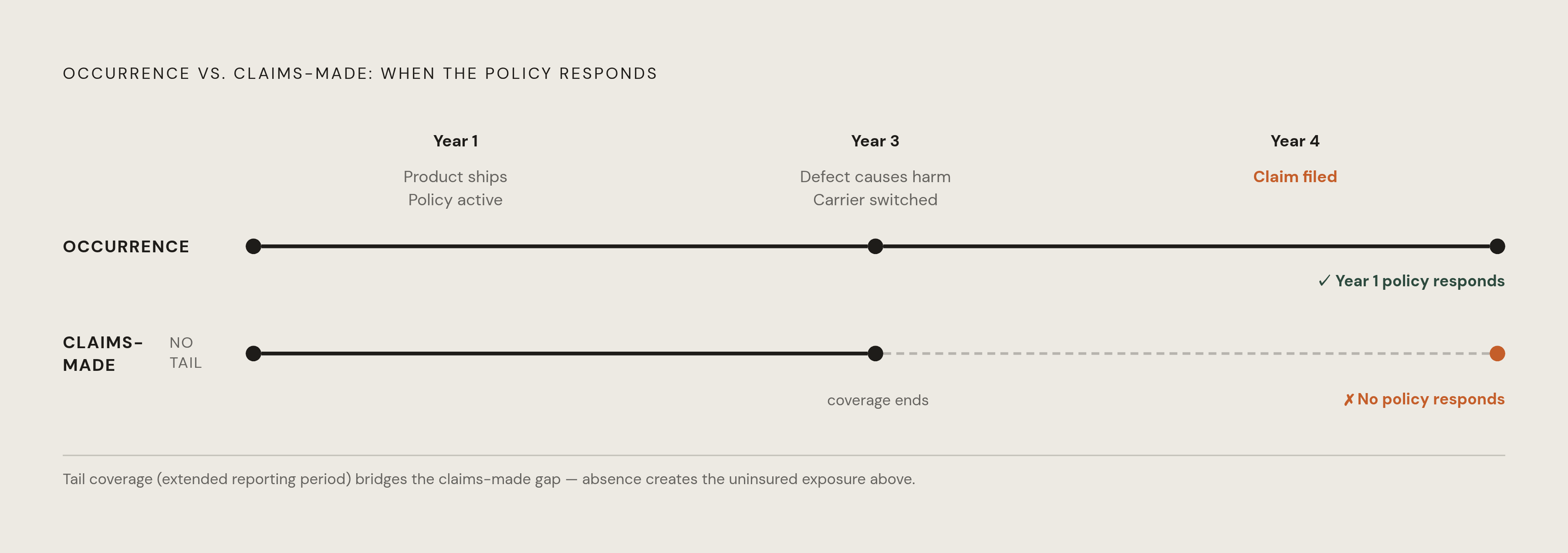
Every liability policy runs on one of two clocks, and knowing which clock applies to which coverage line is the starting point for managing risk in a hardware company. Occurrence form keys off when the incident itself happened, not when the claim shows up. A policy written on an occurrence basis responds to incidents that happen during the policy period no matter when the claim gets filed. The policy active at the time of the incident stays on the hook for the life of that claim. No renewal, no tail, no further action needed to keep the coverage alive. This is the standard form for general liability, for product liability sold in admitted markets, for commercial auto, and for workers' compensation.
Claims-made form works differently, and the difference carries real consequences. A claims-made policy only responds if two things are both true: the claim gets filed and reported to the insurer while the policy is active, and the incident that gave rise to it happened on or after the policy's retroactive date. If either condition is missed, the policy sits silent. This is the standard form for professional liability and Tech E&O, for D&O, for most excess and surplus lines products, and for a number of other specialty lines.
The two forms also behave differently on aggregates and on price. Occurrence policies typically reset their aggregate limit each policy year. Claims-made aggregates don't reset the same way: once a policy period's limit is used up, it stays used up until the company renews at a higher limit or buys more coverage. Pricing follows a different curve too. Occurrence premiums tend to start higher and hold steady. Claims-made premiums usually start lower, but they climb as the policy matures and the accumulated exposure behind it grows.
Hardware's Failure Modes and the Form Distinction
A plumber whose general liability policy covers a leak that happened in 2025 but wasn't discovered until 2026 is the textbook occurrence scenario, and the gap between incident and discovery there is a matter of months. Hardware doesn't work on that timeline. A defect built into a manufacturing run in Year 1 may sit dormant through multiple software updates and years of normal operating cycles, and it may not cause harm until Year 3 or Year 4. The gap between the incident and the claim can span the device's entire working life, and whether that gap matters depends on the form governing the policy in place at shipment.
California treats this exposure with particular severity. It is a strict liability state for product defects. A hardware company can be held fully liable for a defective product even without any negligence in its design or manufacture, and even when the defect originated with a contract manufacturer overseas. Importers and distributors carry that same liability alongside the original manufacturer under California law. A company that outsources production doesn't outsource the risk.
The regulatory backdrop has gotten less forgiving, not more. 2025 set a record for product safety recalls from the relevant regulator, with 339 and counting. Defects that might once have been handled quietly between a company and its customers now tend to generate formal recall actions, with all the notification and documentation obligations that come with them. For autonomous systems specifically, the stakes compound further: a single software update can change a device's physical risk profile overnight, so the risk a carrier underwrote at bind time may not resemble the risk that eventually produces a claim. For autonomous systems and robotics, latent defects in field-deployed hardware can stay dormant for years before turning into claims, and a claims-made form with no active or tail coverage at the moment of filing means nothing gets paid, regardless of what policy was in force when the system shipped. Risklytics, a specialist broker working with companies that deploy autonomous systems and hardware in the field, works with founders to match the policy form to the actual timeline of their product risk.
Occurrence as the Default Form for Product Liability
Physical product liability belongs on occurrence form as the default, and the admitted insurance market treats it that way. Occurrence is the standard form the market reaches for in this category because a physical injury or property damage event has a clear, identifiable moment of loss. The incident happened when it happened, and tying coverage to that moment makes sense for both the carrier and the company.
Claims-made product liability is written instead in the excess and surplus lines market, a segment built to handle specialized, complex, emerging, or higher-hazard risks that standard admitted carriers won't touch. If you're a hardware startup building something genuinely new, running autonomous operation, or carrying a thin loss history, E&S coverage is often the only market that will write the policy. That's a legitimate and common outcome, not a sign of a bad broker or a weak company.
What matters is what a founder takes on when accepting that trade. A claims-made product liability policy from an E&S carrier comes with a set of ongoing management obligations: a retroactive date that has to be tracked and protected, a tail decision that has to get made correctly at every transition, and carrier-switching risk that has to be managed every time the company shops its insurance. That long-tail defect exposure already makes hardware risk harder to underwrite than most other categories of business, and these obligations sit on top of it. Autonomous systems add a further wrinkle: a single incident involving a robot or an autonomous device can simultaneously be a general liability claim for the physical damage, a Tech E&O claim for the algorithmic decision behind it, and potentially a cyber claim if a software update introduced the underlying fault. GL is written occurrence. Tech E&O is written claims-made. The same event can trigger two different policies running on two different clocks, and a company has to manage both correctly at once.
The three variables that determine whether claims-made coverage survives: retroactive dates, tails, and carrier transitions
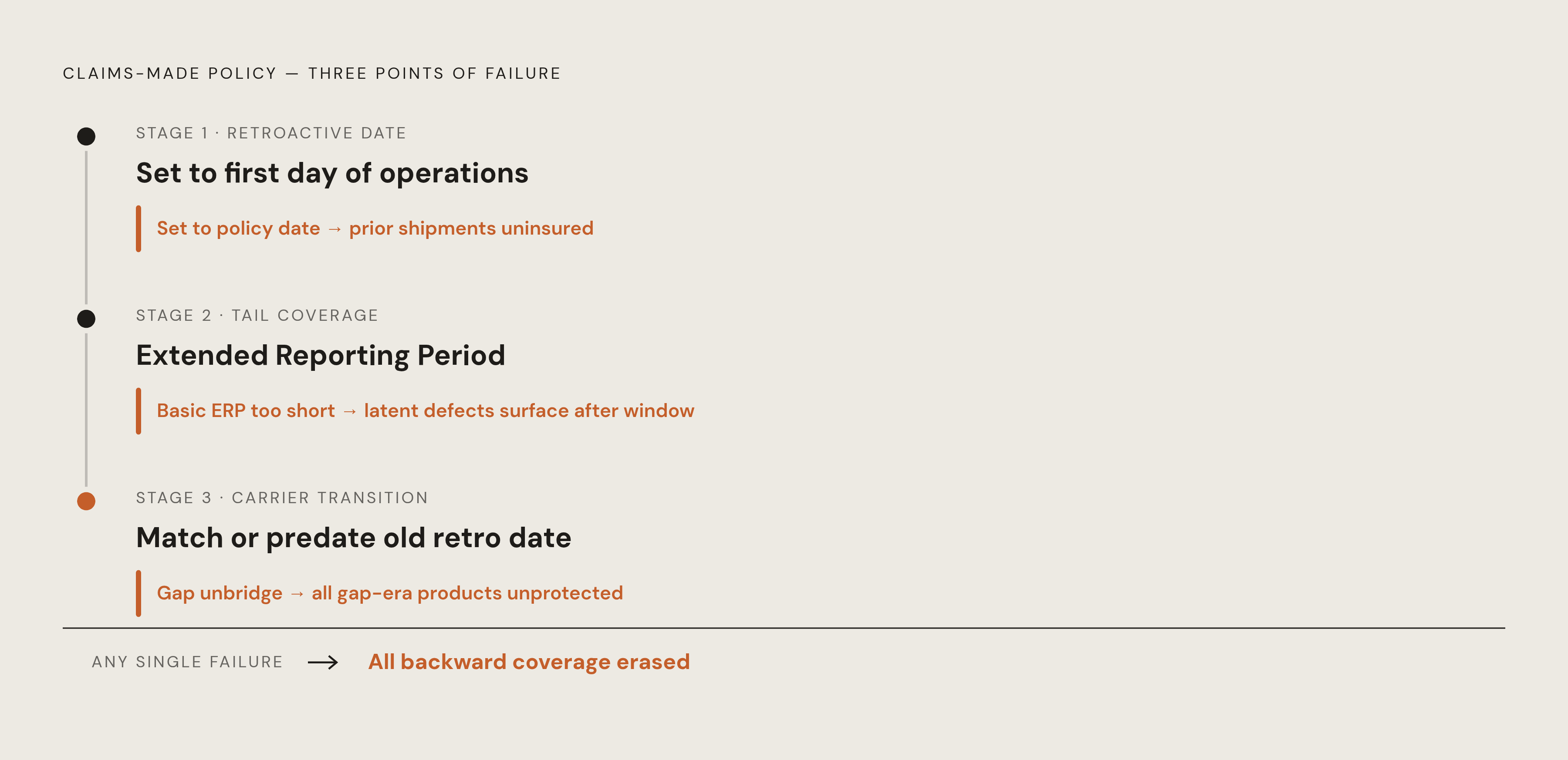
A claims-made policy is only as reliable as three decisions made around it: the retroactive date, the tail coverage, and the discipline applied at every carrier transition. Get any one of them wrong, and the mistake can erase coverage for the entire product history that came before it.
The retroactive date sets the earliest point in time the policy will cover. Any claim tied to an incident before that date gets excluded, no matter how long the policy has otherwise been in force. Founders should push to set this date as early as possible, ideally to the company's first day of commercial operation or the date the first product shipped. A common and costly placement error sets the retroactive date to match the policy's effective date, known as retro-date inception. Every event before that date goes uninsured. Picture a company that bootstraps for two years before buying its first claims-made policy: without backdating the retroactive date to cover that earlier period, anything shipped during those first two years has no coverage behind it.
Tail coverage, formally the Extended Reporting Period, is what keeps a claims-made policy answering claims after the policy itself ends. A Basic Extended Reporting Period comes included automatically, but only for a short window. It is enough to catch claims the company already knew about at cancellation, but it isn't long enough for a latent hardware defect that might not surface for years. Once that reporting period runs out, the policy stops accepting new claims entirely, even for incidents that happened while it was active. That hard cutoff is the core difference from occurrence form, and it's the exact mechanism that opens coverage gaps at acquisition or wind-down. A tail can, in principle, be structured to run indefinitely, which in practice turns the policy into something close to occurrence coverage. That structure costs more and isn't the standard offering, so founders need to ask for it directly and understand what it costs before assuming it's included.
Carrier transitions are where claims-made coverage most often breaks. A funding round that comes with a change in insurance broker and a new carrier needs the new policy's retroactive date set at least as early as the old one, or a tail purchased on the old policy to bridge the gap. If either step is skipped, every product in the field during the window between the two policies has no coverage behind it. Acquisitions carry the same risk in sharper form: a startup that cancels its claims-made policy at close, without buying tail coverage first, loses backward protection for every unit it ever shipped. Wind-down carries the same danger quietly. A company that simply lets its claims-made policy lapse, without a tail, has no coverage for any latent defect that turns up after the lapse, even for products shipped years earlier while the policy was fully active and the premiums were current.
Where Standard GL and Product Liability Policies Fail
Getting the form right solves one problem. It doesn't solve the problem of what the policy actually covers once a claim gets filed, and standard policy language written for conventional risks leaves real gaps for hardware companies.
General liability excludes recall expenses by design: the costs of notifying consumers, retrieving affected units, disposing of them, and replacing inventory. GL covers bodily injury and property damage, not the operational cost of running a recall, and standard GL policies were never built with that exposure in mind. A firmware update that bricks a batch of devices or causes a connected product to malfunction falls into a different gap again: it's a Tech E&O claim, not something product liability covers (which responds to harm from the physical device) and not something standard GL touches either. There's a similar gap on the cyber side. A cyberattack against an autonomous robot that causes property damage can get excluded under a property policy's cyber exclusion, and it can fall outside a cyber policy's scope too, because that policy excludes property damage, so the claim gets stuck between two policies that each assume the other one covers it.
The newest version of this problem involves artificial intelligence specifically. Verisk's ISO Form CG 40 47 01 26, effective January 2026, lets carriers exclude generative AI claims from commercial general liability policies, and that exclusion is now part of the baseline CGL language a standard broker will quote a hardware startup without flagging it. By mid-2026, more than 60 property and casualty insurance groups, including AIG and Great American Insurance Group, had filed AI-related exclusions with state regulators. Berkshire Hathaway, Chubb, and Travelers each sought state regulatory approval to exclude AI-related damages from general liability policies outright, and each got it. If you're building anything with an AI component, including most modern robotics and autonomous hardware, you need to confirm whether your GL policy has adopted language like this before you assume a claim involving an algorithmic failure will be covered.
Specialty programs built specifically for autonomous systems exist, and they close these gaps. Axis Insurance has built a program for companies that make and deploy autonomous robots: it covers bodily injury and property damage from AI navigation or perception failures, physical damage from a cyberattack that takes over a robot's controls, and production losses when a software update or sensor failure takes a robot offline even without physical damage. The program also extends to cases where a defect in a third-party sensor or component causes the failure but the claim lands on the company that integrated the part rather than the one that made it, a structure that matters given how much hardware gets built on top of third-party components.
The Coverage Lines a Hardware Startup Must Stack
No single policy covers a hardware company's full exposure. Building a real program means stacking several coverage lines, each running on its own form convention, and making sure the gaps between them don't line up into a hole.
Product liability sits at the center of that program and carries the form distinction this piece has focused on throughout. It's written occurrence in admitted markets and claims-made in E&S, and it covers bodily injury and property damage caused by the product itself. It can come with add-ons such as discontinued products coverage for items no longer sold but still in the field, worldwide coverage for products that ship internationally, and product withdrawal expense, the specific endorsement that fills the recall gap general liability leaves open. None of these get added automatically. A founder has to ask for them.
General liability runs occurrence, full stop, required by nearly every commercial lease, every enterprise vendor contract, and most co-working memberships, typically written at $1 million per occurrence with a higher aggregate limit, the structure the standard ISO CGL form most commonly carries, though the form itself leaves the actual numbers to be filled in on the declarations page, and it's not something a broker negotiates in admitted markets. The risk with GL isn't the form, since occurrence is fixed. The risk sits in the exclusions: GL doesn't cover recall expenses, professional errors, or data breaches, and none of those are form questions. They're scope questions, and they have to be solved with other lines.
Tech E&O fills part of that remaining scope. Written claims-made, it covers firmware bugs, AI behavioral failures, and connectivity failures that cause a connected device to malfunction, the software-layer liability that both product liability and general liability leave untouched. For a hardware startup building anything connected or autonomous, Tech E&O isn't optional add-on coverage. It catches the failures the rest of the program is specifically built to exclude, and the claims-made management obligations outlined earlier (retroactive dates, tails, carrier transitions) demand the closest attention here, because this is the line most likely to be running on a different clock than everything else in the stack.