Product Liability Coverage Gaps for Autonomous Robots
New AI exclusions and software rules leave robot injuries uninsured.
A stamping press takes a sheet of metal and bends it the same way every time a worker pulls the lever. If the press fails, the chain of causation is short: a design flaw, a manufacturing defect, or a warning that should have been printed on the housing. Product liability law was built around that chain, and it has worked for a century because the machine does not decide anything. An autonomous warehouse robot is also a "product" in the legal sense, but it perceives its surroundings, interprets what it sees, and chooses an action based on conditions nobody programmed in advance. The harm may come from a model the robot's manufacturer never trained, running on sensor input nobody who wrote that model ever anticipated, inside a facility an operator configured well after the underlying safety policy was drafted. That is a different animal from a stamping press, and the insurance architecture built for the press does not transfer to it.
The practical consequence appears the moment something actually goes wrong. A robot maker built the chassis and the actuators. A separate company supplied the AI model that made the decision. The operator on site may have failed to enforce the geofencing or speed limits the manufacturer specified. Contracts between these parties typically assign responsibility on paper, but a single incident, an injured worker, a damaged conveyor, a stopped production line, can still spin into a dispute over which of three failures actually caused the loss. Fault, in other words, rarely belongs to one company anymore, and the industry's underwriting forms were not written with that distribution in mind.
Gallagher Re's 2026 report, Smart Systems, Blind Spots: Rethinking Insurance for the AI Era, produced in association with MIT and Testudo Global Inc., gives this problem a sharper edge. The report found that product liability coverage may respond to injury and property damage caused by AI systems, including autonomous vehicles and robots, but only in jurisdictions where software is treated as a product under the applicable law. Many jurisdictions do not treat it that way, and the report found that coverage does not extend to non-physical harms regardless of jurisdiction. That means the exact same physical injury, caused by the exact same robot running the exact same software, can be covered in one state and uninsured in another, purely as a function of where the claim happens to be filed. A liability framework that produces different outcomes for identical harms based on geography alone is a sign that the underlying doctrine was never built to answer the question autonomous hardware now asks of it.
ISO's 2026 generative-AI exclusions and carrier carve-outs narrowing CGL coverage
This structural mismatch would be serious enough if the insurance market stood still. It is not standing still. In 2025, a standard-setting advisory organization introduced optional generative-AI exclusions for 2026 commercial general liability policies, and carriers are adopting them now. Two endorsements carry the weight of this change. CG 40 47 excludes coverage for bodily injury, property damage, and personal and advertising injury arising out of generative artificial intelligence. CG 40 48 is narrower, excluding only personal and advertising injury. Both define "generative artificial intelligence" broadly enough to sweep in nearly any machine-based system capable of producing an output, a definition wide enough to reach well past chatbots and into the decision-making software running inside a physical robot.
A companion form, CG 35 08, extends the same exclusion into products and completed operations coverage. That detail matters more than it first appears to. It means the exclusion does not just apply to the robot working on a floor today. It reaches backward into the tail of coverage for robots already deployed and already finished with their installation work, and a latent defect is most likely to surface as a claim in that exact period.
Some carriers have gone further than the ISO filings. Multiple carriers filed their own AI exclusions during this period: W.R. Berkley filed what its own language calls an "absolute" AI exclusion across directors and officers, errors and omissions, and fiduciary lines, while Berkshire Hathaway, Chubb, and Travelers primarily sought exclusions on the general liability side. None of this erosion is uniform, and none of it is always labeled clearly. Some carriers are revising base policy forms so that AI-related claims fall outside coverage without any separately named exclusion attached. A summary of last year's policy language tells a buyer nothing about what the current bound policy actually says, and the only reliable check is reading this year's form in full.
The exclusionary language itself carries a wide reach. These endorsements turn on an "arising out of" standard, and courts in jurisdictions that read that phrase expansively will treat a claim as excluded if AI touches the causal chain anywhere, even as a peripheral contributing factor. A claim does not need AI at its center to fall outside the policy. It only needs AI somewhere in the story.
The three layers of autonomous decision-making where coverage gaps specifically open up
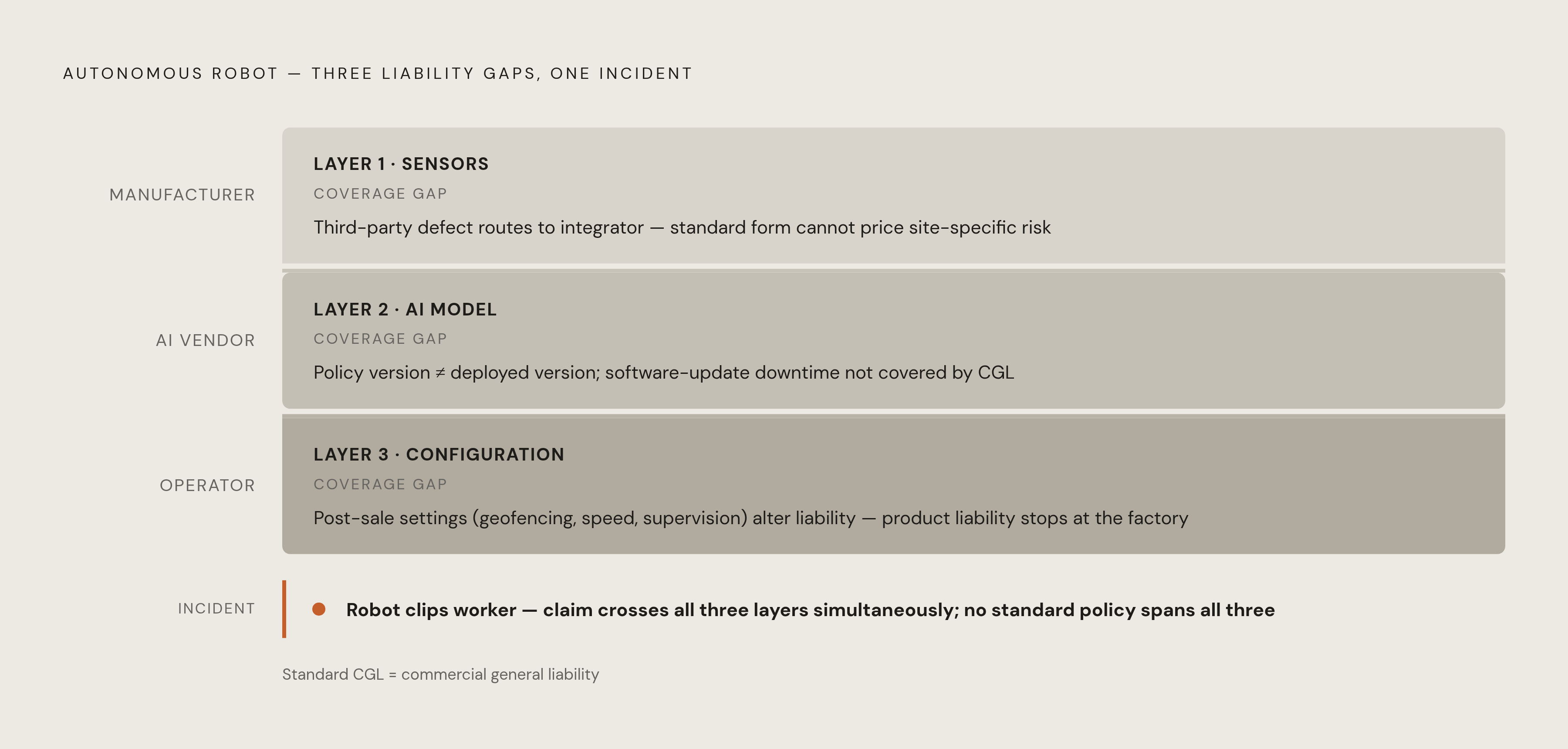
A robot is built from at least three layers of decision-making, and each one raises its own liability question that standard forms never anticipated. Sensors perceive the environment. An AI model interprets that perception and decides what to do. An operator sets the configuration, the geofencing, the speed limits, the supervision rules, that define the envelope the robot is supposed to operate within. Take a single incident, a warehouse robot that clips a worker while moving a pallet: it touches all three layers at once, and each layer points toward a different coverage question.
Start with the sensors. If a defect in a third-party camera or proximity sensor causes the robot to misjudge distance, the claim typically lands on the company that integrated the component into the robot, not on the sensor manufacturer itself. Axis Insurance built a robot-specific program that covers this scenario, where a defect in a third-party sensor or component triggers a failure but the integrating company absorbs the claim, because standard product liability subrogation pathways assume a supplier relationship cleaner than a modular sensor stack actually provides. Sensor risk also varies by location in ways a standard form cannot capture. The same robot model carries different risk in two different warehouses, because floor layouts differ and workers move around the machine differently in each facility, and a standard underwriting form that asks only about the product category has no way to price that site-specific variation.
Move to the AI model itself. A policy underwrites a robot against one software capability level, but software versions change after the policy is written, so the robot may be running an entirely different model by the time an incident occurs, leaving the policy's stated coverage disconnected from the system actually in use. Axis's program also covers production losses triggered by a software update or sensor failure that takes a robot offline, even when no physical damage occurs at all, a loss category that standard CGL does not address in any form.
The third layer sits with the operator. Geofencing, speed limits, interaction rules, and the level of human supervision are all decisions made after the robot has already left the manufacturer's hands, and those post-sale choices decide whether a given incident counts as a foreseeable operating condition or a failure outside the robot's design envelope. Standard product liability forms have no way to price or assign responsibility for configuration decisions made after the sale. They treat the product as it left the factory floor, not as it was configured on the morning of the incident.
What ties the three layers together is how the resulting claim gets framed. The same underlying AI failure can be pleaded as a professional error, as property damage, or as a product defect, and each framing routes the claim toward a different policy line. No single standard form is built to catch a claim that can legitimately be described three different ways, and the gaps between those lines are exactly where coverage disappears.
CGL gaps that Tech E&O and cyber policies leave unfilled
The instinct to patch a CGL gap by pointing to a Tech E&O policy misreads what that coverage was built to do. Tech errors and omissions coverage protects vendors and suppliers of technology, companies that provide technology services to their own customers. It was never built for enterprises or operators that deploy someone else's AI inside their own operations. A logistics company running autonomous robots in its warehouse is using technology, not providing it, and its Tech E&O policy, assuming it carries one at all, likely does not respond to a claim arising from that deployment.
Even robot manufacturers who genuinely qualify as technology vendors run into trouble here. Tech E&O policies often carry exclusions for the specific risks AI systems create: hallucination-related losses, intellectual property infringement, and data disclosure through model outputs. The policy line built for technology vendors excludes the failure modes most unique to the technology those vendors are now selling.
Vendor indemnification clauses do not close this gap either. Most AI vendor agreements cap total liability, including indemnification obligations, at 12 months of fees paid under the contract. For an enterprise paying a modest annual fee for a software platform, that ceiling can be trivial next to the damages a serious incident produces, and the vendor may carry no insurance behind the indemnity promise. A contractual promise to indemnify is only worth as much as the money standing behind it.
Cyber insurance addresses a different problem still: data breaches and network security failures, not the performance failures of an AI system making decisions in the physical world. That boundary is moving. Coalition added an affirmative AI endorsement to its cyber policies in 2024, so an AI-caused security failure counts as a covered event, and coverage now extends to funds-transfer fraud carried out using deepfakes. Even with that expansion, a specific scenario still falls through every line at once: if a cyberattack takes over a robot's controls and the robot causes bodily injury or property damage, cyber coverage may decline the claim because the loss is physical, while CGL may decline it because the trigger was a network intrusion. Specialist robot insurance programs are beginning to close that particular gap explicitly, which is itself evidence that the two established lines, cyber and CGL, were never built to meet in the middle.
Production-loss and financial-loss exposure without physical damage
A software update goes out to a fleet of warehouse robots on a Monday morning, and by the time the first shift arrives, half the fleet is offline. No one is hurt. Nothing is physically damaged. The production line that depends on those robots stops moving for six hours while engineers roll back the update. If an operator in that position opens a standard CGL policy looking for relief, they will find none, because even a CGL policy that survives every AI exclusion discussed above only ever covered bodily injury and property damage. It was never written to cover the revenue a business loses when its own equipment simply stops working.
Axis Insurance's robot-specific program covers exactly this scenario, production losses stemming from a software update or sensor failure that takes a robot offline even without physical damage, and the fact that a specialist program had to build that coverage from scratch is itself a signal. Standard forms were silent on this loss category by design, not by oversight; the entire architecture of general liability insurance assumes that if nothing broke and nobody got hurt, there is no claim to make. For a business running automated fleets, that assumption is backward. A fleet-wide software failure with zero physical damage is close to the most common way these systems actually fail.
AXA XL's Lucy Pilko has drawn a direct parallel to what the cyber insurance market went through roughly a decade ago: losses that were large and concentrated in specific industries, but that fell neatly between the lines of existing policy structures until insurers built standalone products to catch them. Robotics now faces the same mismatch between concentrated losses and policy structure that drove insurers to build standalone cyber products, and mispriced submissions make that mismatch worse before carriers adjust. The same robot carries different risk at two different warehouses, because floor layouts differ, workers interact with the machines differently, and software versions and operating limits change after a policy has already been bound. Even a carrier willing in principle to underwrite production-loss coverage cannot price that risk accurately using a standard form that was built to ask about a product category, not about a specific deployment environment.
How enterprise and government contracts outpace standard insurance policies
This gap usually stops being theoretical the moment a robotics company wins a contract. A pilot program gets approved, the site-access agreement arrives from the customer's legal department, and the required insurance language asks for coverage levels and terms the company's existing policy simply cannot deliver. Customer contracts, particularly with large enterprises and government agencies, drive most of the insurance purchasing decisions in this industry. Expect a requirement for general liability coverage naming the site owner as an additional insured, proof of workers' compensation for any personnel present on site, and in some cases evidence of equipment coverage for machines left on the customer's premises.
A certificate of insurance creates a dangerous illusion of safety here. A certificate confirms that a policy exists somewhere, but it says nothing about whether that policy actually responds to an AI-related claim, and it says nothing about whether the policy carries exclusions for hallucinations, intellectual property infringement, or algorithmic bias. A robotics company can hand over a clean certificate and still carry a policy that would decline the exact claim the customer is most worried about.
Courts and regulators are increasingly treating AI-driven failures as the responsibility of the business deploying the system, even though liability generally still requires a showing of fault, at the same time that vendor accountability is expanding in parallel. That combination puts the operator in a difficult position: naming a vendor as an additional insured on a contract does not protect the operator if the vendor's own policy excludes AI-related losses outright, and the operator can end up absorbing a claim it reasonably believed was someone else's responsibility.
Timing turns this structural problem into a commercial one. Placements involving autonomous systems take longer to underwrite than standard commercial placements, because fewer carriers currently have appetite for the risk, and a pilot program delayed by a missing or inadequate certificate is an expensive way to discover that a coverage gap exists. Buying the right coverage after a pilot has already been scheduled compounds both the cost and the exposure, compared to addressing it before the contract is signed.
Underwriting submissions built for conventional hardware that mispricing autonomous robots
A standard underwriting submission asks about a product category, a manufacturing process, and a loss history built from conventional machinery. It does not ask which AI model is running, what version it was on the day of the claim, how the operator configured the geofencing, or whether the deployment site shares anything meaningful with the sites used to build the underwriter's loss data. Every layer examined in this piece, the sensor stack, the model and its updates, the operator's configuration choices, the contractual coverage requirements stacked on top of all three, traces back to the same underwriting form asking the wrong questions. A robot maker or an operator filling out that form is not lying by leaving the real risk unstated. The form simply never asked. Underwriting submissions need to be rebuilt around how physical AI actually makes decisions, or the coverage bound against them will keep describing a product that no longer exists on the warehouse floor.