Completed Operations Coverage for Autonomous Systems After Sale
Insurance carriers are withdrawing from autonomous system risks standard policies no longer cover.

Completed operations coverage sits at the center of a structural mismatch that most companies selling autonomous hardware have not yet reckoned with. The coverage was built around a defect that exists when a product leaves the manufacturer's hands. An autonomous system keeps making decisions long after that moment, and those decisions are where the harm occurs. Understanding exactly where that gap opens, and what coverage structure closes it, is the essential task for any company putting autonomous machines into the field.
Why completed operations coverage exists and what trigger it was built around
Completed operations coverage, the products-and-completed-operations portion of a general liability policy, responds to bodily injury or property damage that occurs after a product leaves the manufacturer's hands or work is finished. The classical liability model assumes a discoverable, physical flaw: a cracked weld, a mislabeled component, a design error baked into the unit before shipment. The policy asks whether that defect was present when the product was completed.
Occurrence-based policies answer claims by asking when the condition that caused the injury came into being. The trigger is not when the injury happens, but when the condition that produced it was baked into the product. For a static, physical artifact, that line is unambiguous.
How autonomous systems break the "defect at time of sale" logic
Autonomous systems keep making decisions in the field, because sensors, software, and AI models respond to changing conditions after they leave the manufacturer. The harmful act is not a defect frozen at sale but a decision executed in the field, often months or years later. The question the policy asks, whether the defect was present at completion, becomes unanswerable for a system whose behavior is by design adaptive and post-sale.
Zhu's agentic AI insurance framework characterizes the core exposure with precision: agentic systems produce persistent external-state changes through planning, tool invocation, and multi-step decision execution. An autonomous system causes harm when it evaluates an environment and elects an action. The distinction is not subtle. It cuts to the foundation of the coverage trigger.
The risk pathways that arise from this architecture do not map onto the completed-operations defect model at all. Hallucinations, prompt-injection attacks, autonomous decision errors, model drift, and dependency failures can cause harm without any network breach or physical defect present at sale. The exposure is the decision architecture itself, not a flaw in any component installed before shipment. A single robot malfunction can also cross several lines of coverage simultaneously: cyber, bodily injury, property damage, professional liability, and product liability. This is the core structural problem, and it has already begun to reshape the market.
How major carriers are responding — and what their exclusions actually remove from coverage
The standard general liability market has moved decisively to exclude the exposure rather than price it. Berkshire Hathaway, Chubb, and Travelers sought and received regulatory approval across the majority of states to exclude AI-related damages from general liability policies. This is not a tentative adjustment at the margins. It is a coordinated withdrawal from a category of risk that carriers have concluded they cannot underwrite within the structure of a standard GL form. ISO Form CG 40 47, effective January 1, 2026, provides an optional endorsement that excludes bodily injury, property damage, and personal and advertising injury arising from generative AI from commercial general liability policies, in both Coverage A and Coverage B. CG 35 08, a companion form, removes the completed-operations trigger if the harm is AI-driven.
The practical consequence is immediate and concrete. A company that sold an autonomous system before January 2026 under a policy containing completed-operations coverage may find that its renewal policy, or its customer's policy, now excludes the category of harm its product is most likely to cause. The coverage that underwrote the sale disappears at renewal, and the exposure remains with the manufacturer.
If policy language predated widespread AI deployment, do not assume it will respond. A cyber exclusion in a property policy can knock out coverage for a cyber-attack-caused physical loss, while a property-damage exclusion in a cyber policy knocks the same loss back out again. Standard-form policies were not designed with autonomous cyber-physical systems in mind, and the gap between them is real and widening.
What the coverage stack actually needs to look like for an autonomous hardware seller
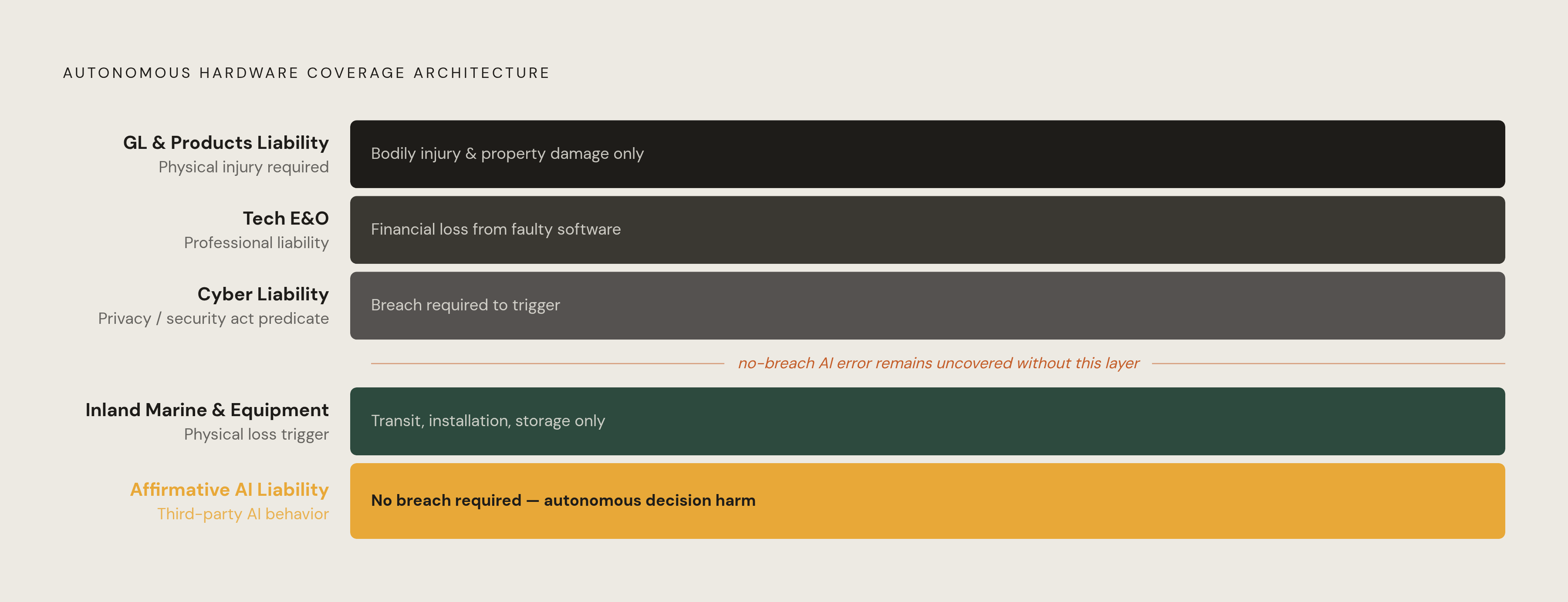
No single policy holds the full risk for an autonomous system in the field. The answer is a coordinated multi-policy structure with explicit allocation rules, not a single line with an autonomous-systems endorsement bolted on. Each line in the stack performs a distinct function, and the failure to understand which trigger applies to which layer of the exposure is where coverage disputes are born.
GL and products liability cover bodily injury and property damage only when there is physical injury. That baseline remains necessary, but it is insufficient on its own after standard-form exclusions take effect. Every GL policy must be reviewed for AI-specific exclusion language, and where possible negotiated with affirmative autonomous-operations coverage that restores the trigger the standard form now removes.
Technology errors and omissions responds to client financial loss from faulty AI software, and to professional-liability claims arising from system behavior. Combined forms that integrate tech E&O, media, and cyber provide broader response, but affirmative wording for hallucination, model drift, or autonomous decision error is not automatic. It must be confirmed in the policy language, clause by clause.
Cyber liability presents a structural limitation that many companies overlook. Standard cyber coverage requires a privacy, security, or media act as a predicate. It handles prompt-injection-to-data-exfiltration, but if there is no security predicate, it won't cover pure AI performance failure. Inland marine and equipment coverage protects the physical hardware during transit, installation, and on-site storage, but it responds to physical loss of the asset, not to the production or operational losses that follow when an autonomous system failure shuts down a customer's operation.
Affirmative AI liability is the layer that addresses what the other lines cannot. Standalone or endorsed AI-specific coverage provides a third-party trigger around AI behavior: underperformance, critical errors, or autonomous decision harm, rather than requiring a breach as a predicate. Mid-market customers want two to five million dollars split across tech E&O and cyber.
The coordinated architecture described in the agentic AI insurance framework integrates cyber, tech E&O, product liability, performance-warranty, and affirmative AI-liability coverages through explicit allocation mechanisms and a dedicated AI aggregate. The goal is a predetermined loss-allocation rule that removes the coverage-friction risk when a claim crosses multiple lines. Cyber-physical extensions, products that expressly address cyber-attack-related bodily injury and property damage, handle the attack pathway but do not solve no-breach AI error. That gap remains open for the largest category of autonomous-system harm, and it is the allocation problem that determines whether a claim resolves cleanly or collapses into litigation between carriers.
Why the underwriting submission determines whether the coverage architecture actually works
Underwriters price uncertainty, and for autonomous systems the submission is the primary evidence they have that the risk is manageable. The coverage architecture described above is not available on a standard form. It exists only where the submission gives an underwriter defensible grounds to offer it.
If you sell autonomous systems, carriers now want far more than a standard GL application. The required material includes an AI inventory covering all models, agents, and tools deployed in the product. Written acceptable-use policies and model governance frameworks, red-teaming documentation and post-deployment monitoring logs, and deterministic safeguard proofs such as kill switches, manual override protocols, and automated intervention mechanisms are also required. They also expect agentic AI oversight controls, AI incident response plans, and continuous telemetry evidence. The telemetry matters because if a claim occurs, the burden of proof rests on audit logs.
The submission is not only a pricing document. It is a legal record of what governance controls the company warranted it had in place. A weak submission that misrepresents or omits controls creates claim-denial exposure that surfaces only after a loss, when the company has no opportunity to correct the record.
A specialist submission for autonomous hardware in the field puts the product's decision architecture, safety controls, telemetry, and governance stack into underwriting language. Large enterprises often require five to ten million in limits, and some contracts set per-claim and aggregate thresholds to match. The submission is the only vehicle that gets a carrier to those numbers without exclusions that defeat the purpose.
What enterprise and government contracts require from autonomous system sellers on insurance
Enterprise procurement has raised its insurance floors materially, and the requirements for autonomous hardware sellers go beyond the GL baseline that most generic commercial programs are built around. Commercial general liability is the baseline in almost every commercial contract. Tech E&O and cyber are non-negotiable additions when you sell AI or autonomous systems to enterprises. The standard endorsement package includes 30-day notice endorsements, additional insured status on GL, and waiver of subrogation.
When hardware autonomy controls physical systems, additional lines appear. Product liability, employment practices liability, crime or funds-transfer fraud coverage, and IP or media liability endorsements all enter the contract requirements, and they scale with customer industry and use-case risk. All three outcomes cost more than getting the program right before the contract is signed.
Government contracting is moving in the same direction, with obligations that extend beyond insurance limits into operational compliance. On March 6, 2026, GSA released draft contract clause GSAR 552.239-7001, "Basic Safeguarding of Artificial Intelligence Systems," which would impose substantial obligations on contractors providing AI solutions to the government. In the autonomous vehicle sector, California CPUC rules illustrate the direction regulators are moving: operators of driverless passenger services face minimum insurance requirements that far exceed standard commercial auto limits, with the specific figure set at five million dollars in commercial liability coverage.
How to approach buying coverage as a company selling autonomous hardware into the field
The first task is mapping the actual deployment: how the system makes decisions in the field, what physical environments it operates in, what human oversight exists, and what a loss scenario actually looks like. A coverage program built on a generic product description will not address the specific exposure, because the exposure is the decision architecture and the environment it acts on. The map comes before the market.
Evaluate the existing program across all lines simultaneously, not policy by policy. Check every AI-specific exclusion across GL, cyber, and tech E&O, and confirm whether the exclusion language was updated post-January 2026 to align with ISO CG 40 47 or similar forms. Identify where autonomous decision-making sits in the coverage trigger for each line, and whether any line requires a human actor as the proximate cause. Then test the cross-policy allocation: if a single incident crosses bodily injury, property damage, and tech failure simultaneously, determine which policy responds first and whether the allocation is explicit or a future dispute waiting to happen.
The governance documentation must be built before approaching the market. Telemetry logs, red-team reports, model governance frameworks, and kill-switch and override documentation serve double duty. They are the submission evidence that drives favorable terms, and they are the claim-time proof that prevents denial. A company that builds this material after binding a policy has already lost the negotiation.
Route the submission to carriers that explicitly underwrite autonomy rather than to standard commercial markets that will slot the risk into a generic form. Specialist carriers who have priced autonomous decision-making risk offer better terms and policies that will actually respond when a post-sale decision causes harm. Koop's autonomous systems insurance platform illustrates what a purpose-built approach covers: general liability, errors and omissions for erroneous system behavior including bodily injury and property damage, cyber, commercial auto for owned or leased vehicles, and equipment coverage for equipment, materials, or products damaged in transit, on land, or during storage at a third-party premise. The choice between a generic submission and a purpose-built one is purely a question of coverage quality and claim outcomes.
The industry's own evidence suggests that well-governed autonomous systems can outperform human-operated equivalents on the metrics insurers care about. Swiss Re compared tens of millions of miles of Waymo's driverless driving against a large database of real claims from human drivers and found Waymo generated 88% fewer property-damage claims. The question is whether the company selling the system has built the structure that does.