Inland Marine Insurance for Robotics Hardware in the Field
An equipment floater protects robots where location-based policies stop.

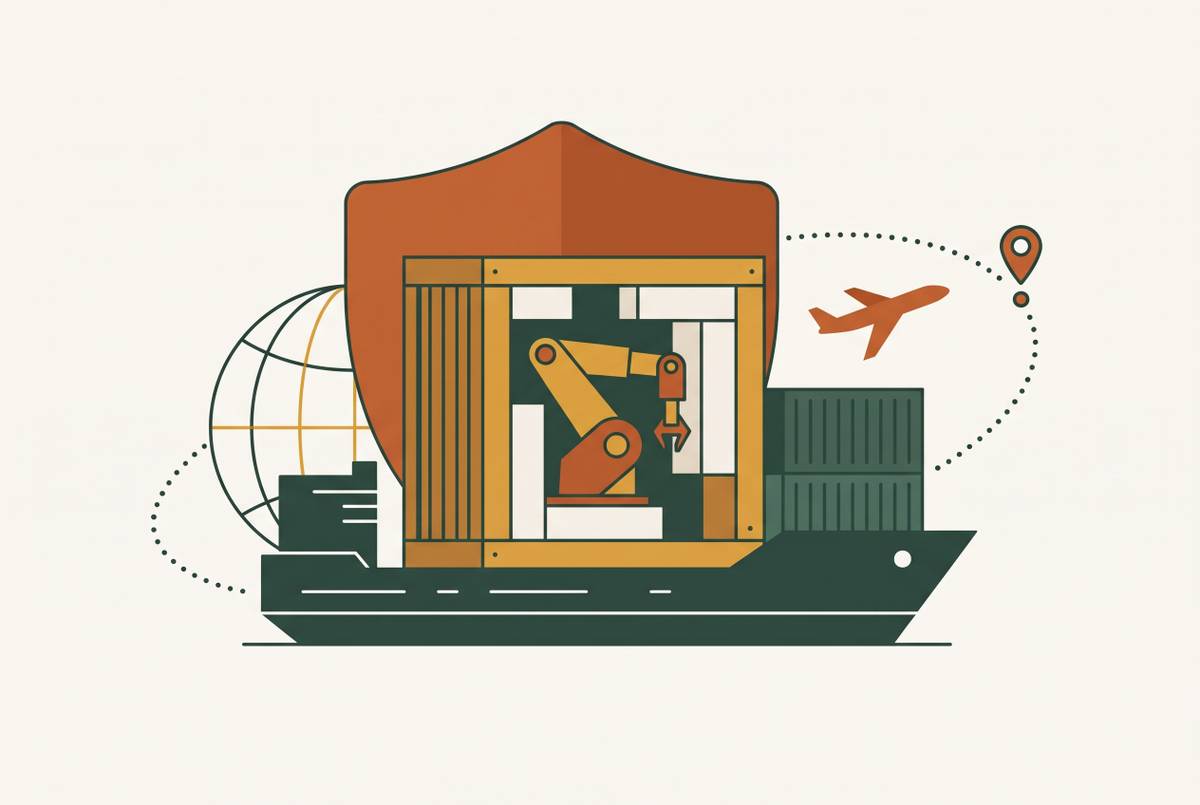
Inland marine insurance covers deployed robotics hardware as it moves between job sites, customer pilots, and demonstrations, subject to the policy’s terms. It is usually written as an equipment floater and protects the company’s own machines where location-based commercial property coverage falls short. For a mobile robot fleet operating across multiple locations, it is the property anchor of the insurance program.
Why field-deployed robotics hardware is not covered by the policies most founders think cover it
The moment a robot leaves the lab, its exposure changes. Hardware can be crushed in transit, dropped from a dock, or hit by a forklift on a customer floor. Yet standard commercial property insurance is built for assets that stay at fixed, named locations. A robot’s working life takes it beyond that perimeter, often for weeks or months.
A building or business personal property policy covers property at a schedule of locations, while deployed machines move between sites the robotics company does not own. Unlisted locations are typically uninsured or subject to smaller limits.
The contracting process often exposes this mismatch before deployment. Most customer sites ask for certificates before a machine passes through the gate, but proof of general liability insurance does not show that the machine itself is covered. Commercial general liability, or CGL, responds to third-party bodily injury and property damage. It does not cover the insured’s own damaged robot, even when that robot is operating at someone else’s premises.
What inland marine actually is and why the name obscures what it does
Inland marine is a class of coverage for property in transit over land, movable property, and certain fixed instrumentalities of transportation and communication. For robotics companies, the relevant application is equipment that leaves the insured’s premises and works elsewhere.
The terminology is a holdover from cargo insurance. Inland coverage began as insurance for goods moving by barge, rail, and wagon where ocean marine policies did not reach. To a software-forward robotics company, “marine” can therefore sound like a reason to dismiss the line.
An equipment floater can follow that hardware across locations. A single inland marine policy can cover a unit being trucked to a customer, remaining on the customer’s floor during a 90-day pilot, and appearing at a trade show. By contrast, adding a new site to a location-based property policy requires an endorsement, and unlisted locations may receive little or no protection.
The five coverage lines a deployed robotics program actually needs, and where inland marine sits among them
A deployed robotics program needs five working coverage lines because its losses do not all belong to the same category. CGL addresses bodily injury and damage to third-party property, subject to its terms and exclusions. Inland marine covers damage to the insured’s equipment, and each unit is scheduled at replacement cost. These are separate sides of a physical incident. A machine can damage a customer’s property and be damaged itself, so both coverage lines have a role in the same incident.
Workers’ compensation addresses the employees who install, service, and supervise the machines. It is legally required in most states once employees are on payroll, with limits set by state law. Field work also changes the underwriting picture. Technicians traveling with hardware rate higher than engineers working at desks, so treating the workforce as entirely office-based leaves an important part of the exposure undescribed.
The company needs Technology errors and omissions insurance when it licenses its autonomy stack, including a perception model, navigation service, or control policy. It addresses financial harm from software or services failing to perform. Umbrella or excess coverage supplies additional limits when enterprise master agreements and utility or hospital contracts require more than the primary policies provide.
The program’s logic follows who or what suffers the loss. Third parties, employees, customers who rely on software, and the company’s own machines each need different insurance. Inland marine is the property anchor because none of the other lines is structured to follow the company’s hardware through transit and deployment. Each coverage line still has its own job when a customer treats insurance as a single paperwork requirement in its contracting process.
What insurance covers autonomous robots traveling between job sites?
Inland marine follows the operational sequence of transit, staging, pilot, demonstration, and return. That sequence starts before the robot performs any work. Hardware moving by truck, rail, or air between facilities, to a customer site, or to a trade show faces handling damage, vibration, and accidents. Transit is a period when physical damage is especially likely, even though the autonomy system may have no role in the loss.
During staging and a pilot, the machine may sit or operate at a location the robotics company does not own for weeks or months. Inland marine can cover it there without making the customer site a named insured location.
Demonstrations compress several exposures into a short period. On a loading dock, forklifts and handling put the machine at risk, while unfamiliar handlers and surfaces make what happens at the venue less certain. The home office’s standard property policy does not cover those off-site exposures in a useful way. An equipment floater can encompass the demonstration as part of the machine’s working life.
The return journey belongs to the same exposure picture. For a fleet, however, following the route is only part of the coverage task, because the amount at risk depends on the units deployed. Each unit’s scheduled replacement cost gives the underwriter the values used to price the policy. A large fleet is therefore a materially different insurance proposition from a single-unit deployment, even when both follow the same transit-to-pilot-to-demo sequence.
How the AI exclusion wave is now eating into the CGL coverage that robotics companies assumed would backstop their hardware risks
ISO issued new generative AI exclusions for CGL in January 2026, making the contraction of liability protection concrete at the policy-form level. CG 35 08 excludes bodily injury and property damage arising out of generative AI under the Products/Completed Operations liability coverage part. CG 40 47 excludes bodily injury, property damage, and personal and advertising injury arising from generative AI systems across Coverage A and Coverage B. These are not interchangeable exclusions, but both narrow protection for specified AI-related losses.
State regulators approved the vast majority of carrier requests to adopt these exclusions, and they took effect in several states as early as January 2026. Coverage that had been silent about AI is becoming subject to express exclusions as carriers file endorsements. A certificate showing CGL coverage does not, by itself, reveal how those exclusions affect a particular operation.
Earlier assumptions about implicit coverage under CGL or property policies did not make CGL insurance for the company’s own equipment. The new exclusions reduce the third-party liability protection a robotics company may have counted on when its machines cause harm. Exclusions written for generative AI should not be read as automatically excluding every autonomous system. Their scope depends on the wording and the operation involved.
Standalone specialty AI liability products do not resolve the property gap. Their limits are currently modest relative to the litigation exposures facing the largest AI deployers, and they do not substitute for equipment insurance. CG 35 08 and CG 40 47 do not apply to inland marine, which protects the insured’s assets under a separate form. That separation reinforces the equipment floater’s central role, although its own exclusions still require scrutiny.
How the segments of the robotics market — warehouse AMRs, field robots, humanoids — shape what the inland marine policy needs to say
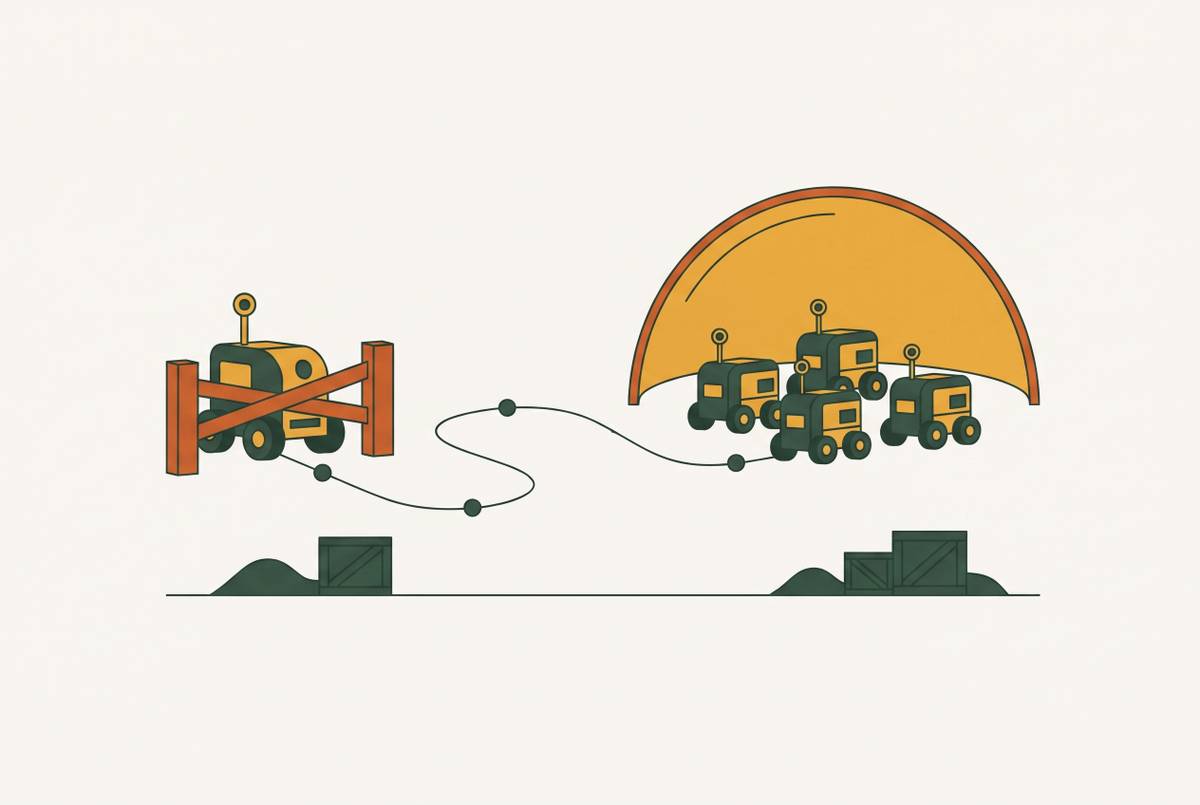
The operating environment determines the physical damage exposure and the questions an underwriter must resolve. Warehouse autonomous mobile robots typically work in controlled, fenced, or mapped environments, where racking, product, and forklifts define much of the collision picture. For their inland marine coverage, unit replacement cost and fleet size are central valuation questions. A controlled environment still contains physical hazards. The submission must describe those hazards rather than relying on the label “warehouse robot” to explain them.
Humanoid and legged platforms present a different combination of risks. They work in spaces built for people, which puts bodily injury at the front of the liability file. For inland marine, the same fall or collision can also destroy a high-value machine. Neither exposure can stand in for the other when the program is designed.
Sidewalk delivery robots face risks on public infrastructure. Pedestrians, cyclists, and municipal permits enter the picture, and the insured does not control the operating location as it might control a warehouse floor. That mobility fits the purpose of an equipment floater, but it also requires a clear description of where and how the robot works. A generic mobile-equipment description leaves out the conditions that distinguish the risk.
Operating-envelope disclosures make those differences available to the underwriter. Supervision ratios, emergency stops, geofencing, and incident logs describe the limits within which a machine operates and the controls supporting its deployment. Without that detail, a generic submission can result in pricing that treats the robot like rented construction equipment, terms padded with exclusions, or no quote at all.
Why the underwriting submission is the mechanism that determines whether inland marine coverage actually performs at claim time
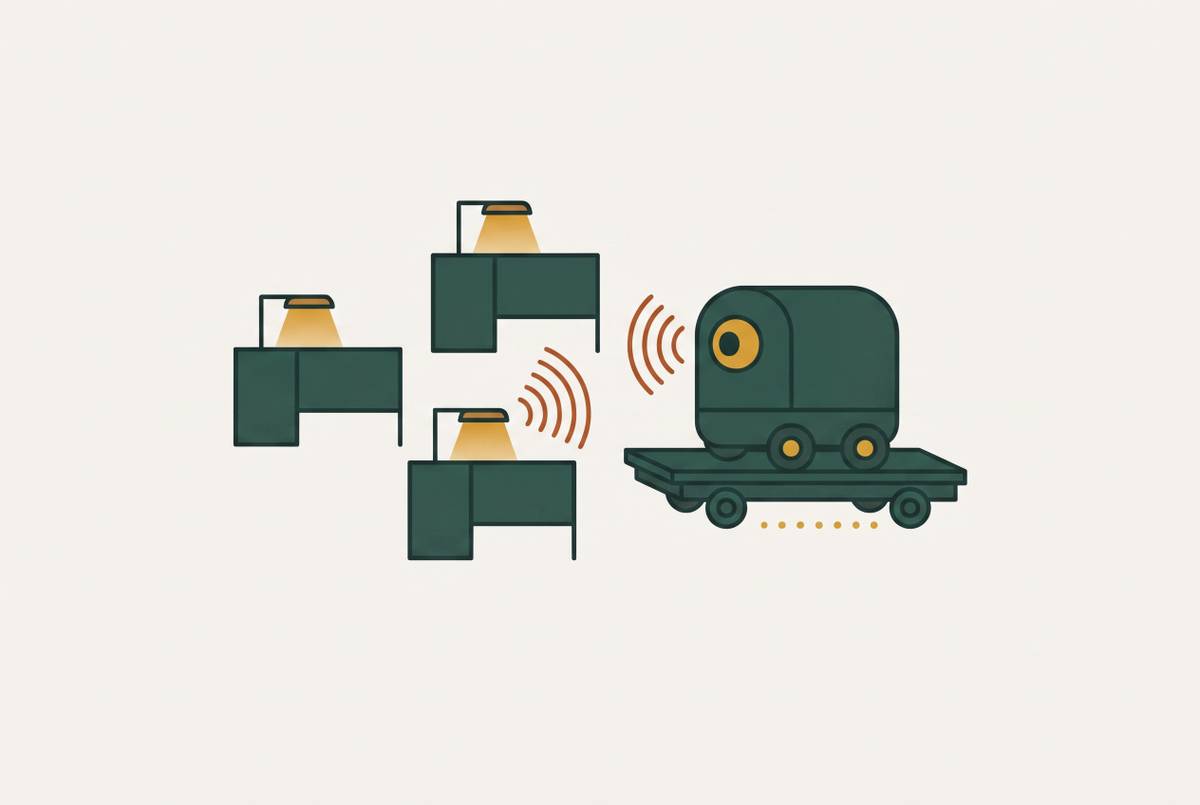
Binding a policy does not establish that its coverage matches the fleet. Standard commercial application forms have no fields for supervision models, operating envelopes, geofencing, emergency stops, or safety cases. Those omissions leave the underwriter without information needed to distinguish autonomous equipment from more conventional mobile machinery. The lesson for a robotics company is to make its operating description part of the submission.
The equipment schedule requires the same precision as the operating description. If a unit is scheduled below its actual replacement cost, the policy pays below replacement cost at claim time. The company may only learn of the shortfall when a loss occurs. Correct scheduled values must therefore be established at submission.
Carriers increasingly use external data sources to validate risk characteristics, and incorrect or outdated third-party information can affect pricing, deductibles, or even produce a declination. A description that conflicts with public information about the machine’s operating environment creates friction. Accuracy is therefore not just a question of completing the application. It includes presenting a coherent account of where the robot works and under what controls.
A specialist broker's contribution is to connect that account to the contract before binding, which is the work Risklytics, a commercial insurance brokerage focused on robotics and autonomous hardware, does when it places inland marine for robot fleets instead of defaulting to a standard equipment floater. Reading the policy form at that stage can expose exclusions that conflict with the machine’s actual operation, including AI-related restrictions in a mobile equipment form. The separation from CGL exclusions is not blanket immunity. Incident logs, supervision ratios, and documented emergency-stop protocols then become underwriting inputs that the broker can translate into premium and coverage terms. The submission is where the fleet’s operating reality becomes the insured risk.