Why Standard Equipment Floaters Fail Autonomous Robots Moving Between Job Sites
Floaters were built for human-run machines, leaving robot fleets exposed.
Inland marine coverage for robot fleets in use needs to cover scheduled hardware as well as autonomous operation, travel between job sites, and software-driven changes in behavior. Standard equipment floaters leave gaps because their cause-of-loss language, territorial conditions, and exclusions were written for machinery that people control. A workable program pairs modified hardware coverage with cyber, liability, and downtime protection written to address the same incident without excluding it between policies.
What a standard equipment floater was designed to cover
A standard equipment floater extends property protection beyond the operator’s own premises. It follows scheduled mobile equipment between locations and covers sudden, accidental physical loss from named perils, including theft, fire, collision, and vandalism. Its purpose is concrete and limited. The insurer values the machine and covers specified events that damage or destroy it, rather than the decisions that determine how it moves.
That design suits equipment transported by people, operated under human control, and left inert between uses. “Mobile” describes where the equipment can be taken. The floater pays to repair or replace the physical unit, but it does not cover lost revenue or production downtime while the equipment is unavailable.
The founding assumptions that made the floater work — and why they break with autonomous robots
The floater’s structure rests on three assumptions, namely human control, a stable risk profile, and an identifiable physical cause of loss. These assumptions made the original product workable. An autonomous robot breaks them because sensors, software, and AI models make consequential decisions as conditions change. The equipment does not merely execute an operator’s fixed commands. Its decision-making becomes part of the exposure, while the policy remains organized around the value and physical condition of the hardware.
A software update also separates the risk underwritten from the risk deployed. The fleet reviewed last quarter may use different decision logic this quarter, even though all its physical parts are the same. Traditional underwriting has no mechanism for treating a software push as a mid-term change in risk. The machine’s appearance can remain the same. Its behavior need not, which weakens the assumption that the exposure stays stable between policy reviews.
The third assumption fails when one incident blends hardware, software, and autonomous decisions. A damaged robot may be the endpoint of sensor degradation, faulty perception, or a bad model update. IMA Financial’s advanced manufacturing report describes how fault can be spread across interconnected autonomous systems, so root-cause analysis takes longer and defense costs rise. The form was built for a different relationship between equipment, control, and loss. Risklytics, a commercial insurance brokerage that places inland marine and related coverage for robot fleets, is one specialist option for operators whose machines outgrow those standard floaters.
How cause-of-loss definitions exclude the failures autonomous robots actually have
Standard floaters cover specified physical perils but exclude wear and tear, mechanical breakdown unless endorsed, and losses caused by defective materials, poor design, or faulty workmanship. Those boundaries distinguish an external accident from a machine’s own failure. For an autonomous robot, however, the initiating fault often lies inside the system that controls it.
A perception model can make a wrong call, a sensor array can degrade between calibration cycles, or a navigation update can change behavior in an edge case. None maps cleanly to a named physical peril. Mechanical breakdown and inherent-defect exclusions can also fence out the resulting loss. A robot that stops working on an insured job site has therefore not necessarily suffered an insured event. Even where a collision follows, the initiating software or sensor fault creates a coverage question that the word “collision” alone does not resolve.
Aircraft have historically needed specialized endorsements because they fall outside traditional form assumptions, and autonomous ground robots present a comparable structural mismatch. Downtime then adds a separate exposure, because a single robot failure can halt a dependent workflow even if the floater pays to repair the unit.
Why territorial and location triggers misfire as robots move between job sites
A floater’s mobility does not mean unrestricted coverage wherever equipment goes. Scheduling requirements and territorial provisions assume the insurer can identify where the machine will operate and under what conditions. Those boundaries are part of the underwriting. A robot that receives an assignment and self-routes to another site can cross a defined territory or reach an unscheduled location without a person expressly choosing that movement.
Two warehouses can have different floor layouts, worker proximity, and surface conditions, so the same robot can present a different risk at each. A floater prices a risk profile at binding. Its scheduling mechanism does not regrade that profile as the robot reassigns itself, leaving a gap between the equipment description and the conditions in which it works.
Custody conditions create another point of friction. Requirements to lock, supervise, or secure equipment when it is not in use were written around machinery whose working and idle states were controlled by people. They sit uneasily with equipment designed to operate without a person at the controls. Autonomous operation makes the wording of those conditions consequential. Coverage for travel between sites must account for where the machine is allowed to go and the conditions it must meet while there.
How cyber exclusions in property forms cut out the loss mode most likely to down an autonomous robot
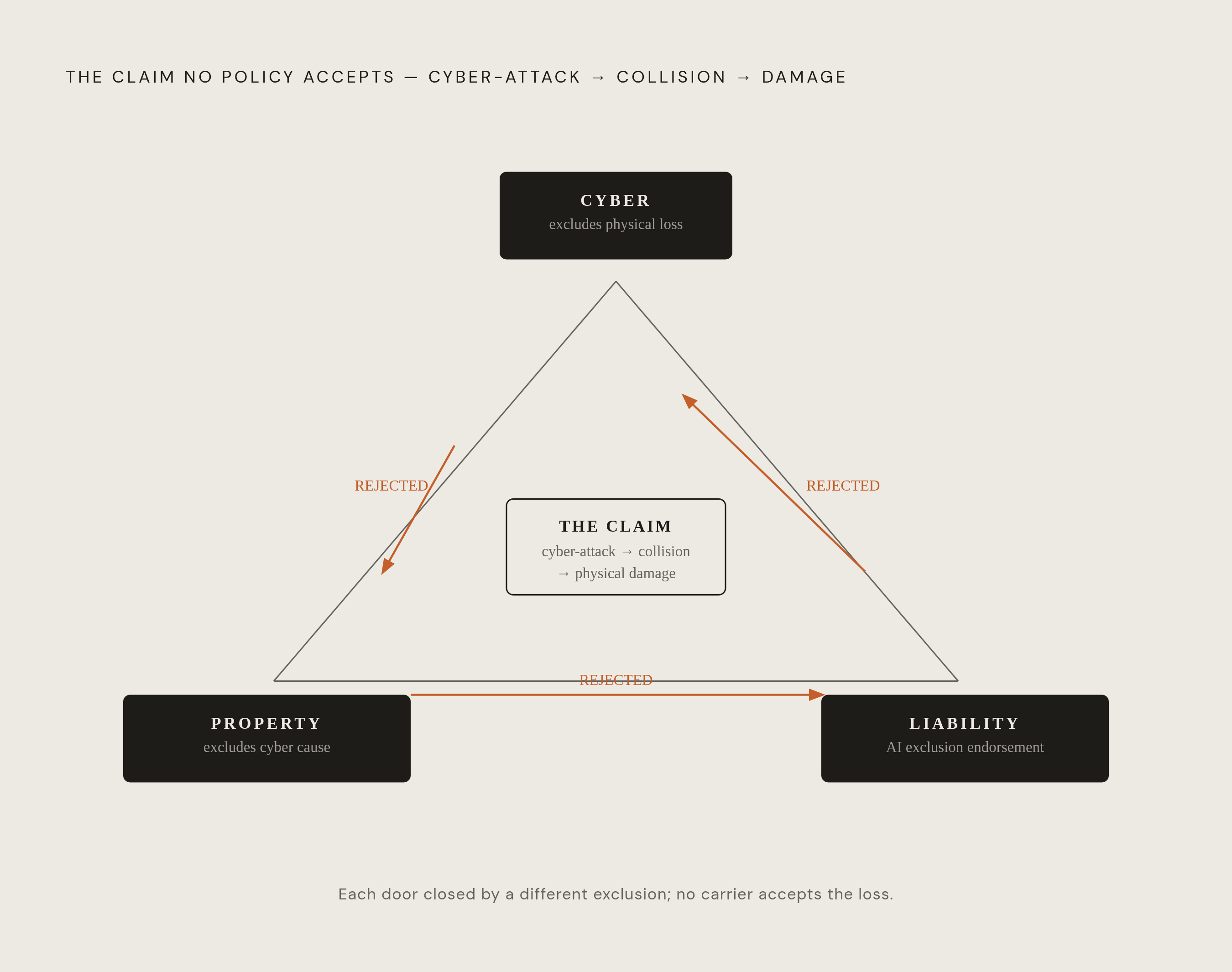
A compromised control system can cause a collision and physical damage. The property form may exclude the event as cyber-related, while the cyber policy may exclude the damage because it is physical. Forms written independently may leave neither policy accepting the resulting claim.
WTW’s Andrew Hill frames the issue directly. “For example, could a cyber attack against an autonomous robot that results in property damage be excluded under a property policy because of a cyber exclusion, while also falling outside the scope of a cyber policy because of a property damage exclusion?” Buying more property or cyber insurance does not resolve two exclusions that direct the same loss away from coverage at the trigger.
Data poisoning makes the gap harder to classify because the attack corrupts behavior. IMA’s report describes attacks that corrupt AI models, disable robotic systems, and halt production, leading to business interruption and third-party liability claims across systems that are linked together. A breach-based cyber policy may not respond to that chain as expected. An authorized manufacturer update can cause a similar problem with no attacker involved, because a software fault that changes behavior may fall outside both a breach and a named physical peril.
How ISO's 2026 AI exclusion endorsements and the agentic AI wave compound every gap above
ISO’s endorsements effective January 1, 2026 allow insurers to exclude losses arising from generative AI from standard commercial general liability policies. Their definition covers data-trained, machine-based systems that can produce outputs, which could include an autonomous robot’s decision-making layer. IMA’s report identifies that breadth as a concern. The endorsements can remove protection elsewhere in the program for an incident the floater cannot address.
Previously, much AI exposure remained “silent AI,” neither expressly covered nor expressly excluded. That ambiguity left coverage to be argued after a claim. An adopted AI exclusion changes the starting point. Absolute AI exclusions in management and professional liability lines, including D&O, EPLI, and Fiduciary, can extend beyond generative AI or a particular cause of action. These exclusions indicate the market’s direction.
Verisk said in July 2026 that it was weighing exclusions specifically for agentic AI. That proposed second wave would address autonomous systems more directly, widening the potential gap between a robot’s activity and its insurance program. At the same time, the EU’s Revised Product Liability Directive applies from 9 December 2026 and recognizes software and AI systems as products subject to product liability law. A defective AI model can therefore lead to product liability as well as a physical loss.
Why the liability chain for an autonomous robot incident is longer than the floater assumes
A damaged robot raises a property claim, but a robot that injures someone raises questions about everyone involved in its behavior. The hardware manufacturer, AI model supplier, systems integrator, and operator can all face claims arising from one incident. IMA’s report describes responsibility extending across those who make, operate, program, own, and oversee a cobot. The floater does not allocate that responsibility. As a property policy, it does not respond to those third-party liability exposures even when it pays for the robot itself.
Autonomy complicates the allocation because the end user may not control the decision that caused harm. An emerging view links responsibility to the level of autonomy, shifting more of the burden toward manufacturers and software developers as autonomous decision-making increases. That position is not settled in most jurisdictions. Operators remain exposed while the allocation is contested, and fragmented root causes can draw several parties into the same dispute. If general liability coverage excludes the AI-related injury claim, the operator may also lose the defense it expected.
Removing human error can make collisions less frequent, but a collision may call for sensor recalibration, radar replacement, and software revalidation beyond a simple physical repair. Past loss data is hard to use as a guide to pricing when software versions and operating limits change after underwriting. Meanwhile, more enterprise and government customers require insurance certificates before a robot enters a facility. Those contracts require coverage for the robot’s liability as well as the replacement value that the floater protects.
How do you insure a fleet of mobile robots operating across multiple locations?
Inland marine remains the appropriate vehicle for hardware coverage, but its wording must reflect autonomous navigation, multi-site deployment, software-driven behavior changes, and the relevant causes of loss. Hardware coverage is still only one component. Cyber, liability, and downtime protection must address the same blended incidents without leaving physical damage, software failure, or autonomous decisions outside every form.
Specialist products illustrate what that broader design can cover. AXIS Insurance built a program that covers production losses from software updates or sensor faults even when there is no physical damage. It also covers cases in which a third-party sensor or component defect causes a failure but the claim reaches the integrator. Tokio Marine & Nichido Fire Insurance announced a robot product in October 2026 for launch in November that covers repair or replacement after collisions or natural disasters along with third-party injury and property damage. It also pays substitute-worker wages or stand-in robot rental fees during an outage, with premiums set individually by use and operating environment.
The operating model needs to be explicit in the underwriting submission. A standard commercial application has no fields for supervision ratios, operating envelopes, geofencing, emergency stops, or safety cases. Those details distinguish an autonomous fleet from rented construction equipment and give specialist underwriters a clearer basis for terms. A specialist broker who describes those controls and reads the policies before binding is the mechanism for closing the gaps.