From Equipment Floater Denial to Inland Marine Placement for a Deployed Robot Fleet
Specialist inland marine placement closes gaps standard floaters leave for autonomous robots.

Inland marine coverage for deployed robot fleets requires a specialist placement that accounts for autonomous operation, physical damage, and movement between sites. A standard equipment floater addresses portability, leaving the software-driven behavior that shapes a robot fleet’s losses outside its scope. Effective coverage pairs a purpose-built physical-asset placement with separate software and cyber protection, supported by underwriting evidence of how the fleet operates and how failures are stopped.
Why a standard equipment floater was never built to cover a deployed robot fleet
An underwriter receives an equipment floater submission for a fleet of autonomous ground robots and cannot price the risk because the form does not map to how the machines operate. The submission describes movable equipment, but the underwriting framework expects contractor-owned machinery operated by people. A schedule of units and values can describe the assets without explaining the autonomous behavior that determines their exposure to loss.
Jensen Agency's guide describes an equipment floater as coverage focused exclusively on contractor-owned machinery, including generators, excavators, backhoes, and loaders. These machines are essential to daily operations and frequently move between job locations. The form’s underlying logic is physical portability. Coverage follows the equipment’s location, but the standard framework has no mechanism for assessing how autonomous equipment behaves after it arrives.
Carlstan's inland marine guide explains that standard commercial property policies usually cover items only at the insured address named in the policy. Inland marine and floater forms fill that location gap by covering property when it is away from fixed premises. A deployed robot introduces a second gap. It does not merely travel to a job site, where a person takes the controls, but makes decisions and executes tasks autonomously. The denial therefore reflects an architectural problem rather than a missing piece of paperwork, because the form solves the problem of location without addressing the problem of autonomous operation.
What inland marine coverage is actually built to do, and where its design stops
Inland marine remains the appropriate coverage category for property that moves and operates away from a fixed address. Its flexibility is a strength. The same guide lists IT infrastructure at client locations and medical equipment moved between offices as property that inland marine can cover. Property need not remain at the insured’s premises to be a suitable physical asset for coverage.
Autonomous robots are a natural extension of that logic, but they are not yet a named class in standard floater forms. That distinction separates the coverage line from the particular instrument used to place it. The category is broader than the contractor form. Treating the two as interchangeable obscures the reason an otherwise appropriate line can produce an inadequate placement.
A generalist underwriter uses the form’s loss-history assumptions to assess a contractor equipment submission. Those assumptions do not account for algorithmic behavior, software-caused failure, or fleet-wide events triggered by a single software push. Such an event changes the unit of risk. The exposure is no longer explained solely by the value and location of each machine, because one software event can affect the fleet. Specialist framing is therefore needed to connect the physical property being insured with the operational causes of loss that the standard submission leaves outside its model.
The specific exclusions on a standard floater that erase coverage for a robot fleet
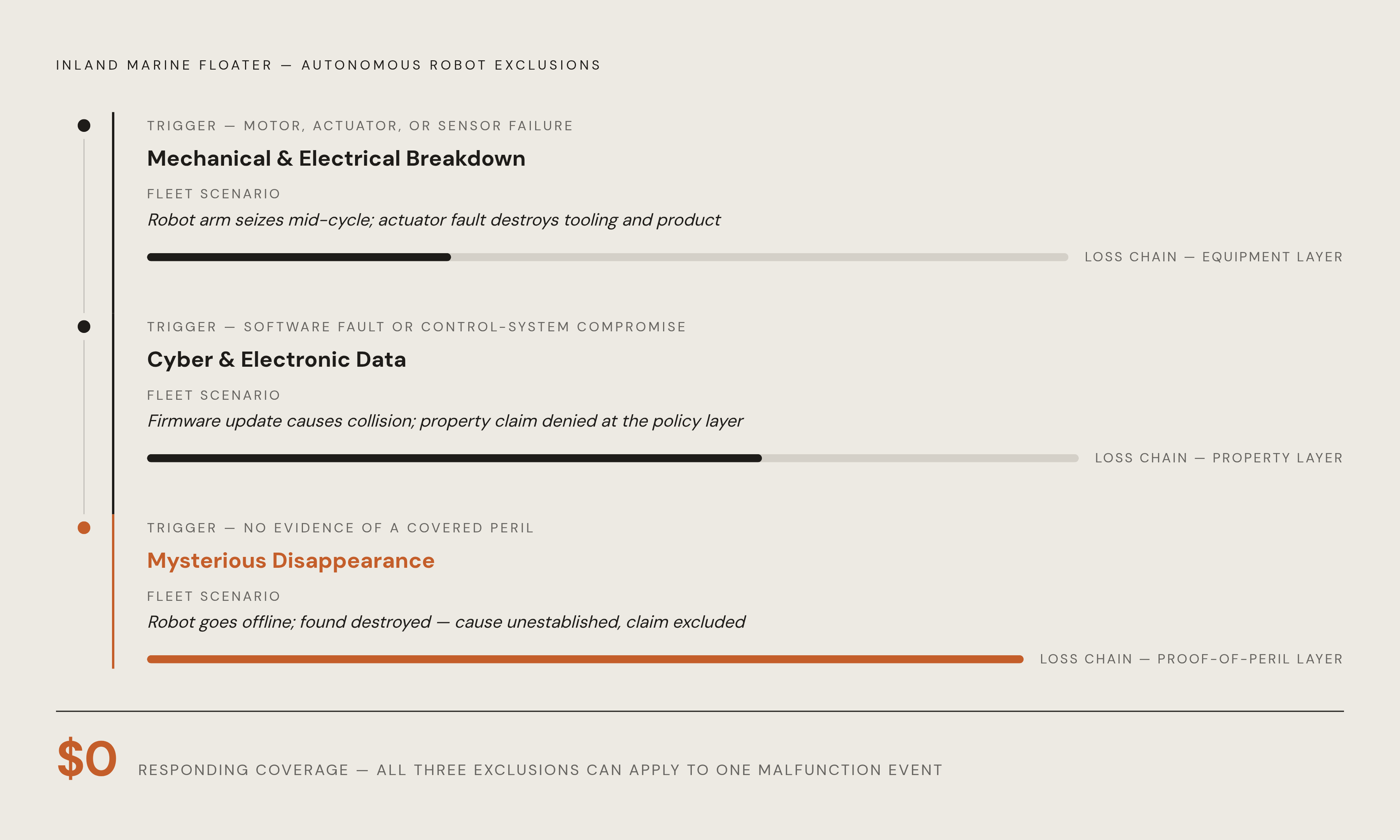
Mechanical and electrical breakdown exclusions can prevent a payout for damaged robot hardware. Insurance Pro Agencies' guide explicitly lists mechanical or electrical breakdown in the “What It Does NOT Cover” column of a standard inland marine form. Equipment breakdown insurance is a separate product. For a deployed robot whose motor, actuator, or sensor array fails in the field, the breakdown exclusion can remove coverage for the failure even though the damaged component belongs to a scheduled asset. Naming the robot on the policy does not make every cause of damage insured.
Cyber and electronic data exclusions operate at a different point in the loss chain. Standard floater forms exclude losses arising from electronic data, cyber events, or software. For a robot governed by a software stack, a control-system compromise or software-induced collision can therefore be excluded at the property layer. The cause of that damage can place the loss outside coverage before any question of liability to another party arises.
Mysterious disappearance provisions create a further obstacle when evidence of a covered peril is missing. Some standard floaters exclude loss of property without that evidence. A robot that goes offline, stops responding to telemetry, and is later found destroyed may not meet the form’s evidentiary requirement. Finding the damaged unit does not necessarily establish a covered cause. The loss must still satisfy the policy language rather than merely demonstrate that the equipment has been destroyed.
Under those standard terms, claims for physical theft or fire may still be paid, while losses caused by the fleet’s autonomous operation fall outside coverage.
How the AI exclusion wave compounds the problem at every other coverage layer
New ISO endorsements and carrier filings effective in 2026 limit what general liability and directors and officers coverage will pay for generative-AI losses through ISO endorsements and carrier absolute-AI exclusions. Adoption is not uniform, and some implementation is delayed. An operator’s exposure depends on the language actually attached to its policies.
Cyber coverage is moving in parallel through AI sublimits and outright exclusions. A sublimit restricts how much of a cyber tower responds to an AI-related loss, even where the policy otherwise provides coverage. That can leave a substantial uninsured remainder. A fleet-control-system compromise may produce a claim far larger than the applicable AI sublimit, so the tower’s overall limit does not establish how much protection is available for that event.
W. R. Berkley introduced what was described as a first-of-its-kind absolute AI exclusion for directors and officers, errors and omissions, and fiduciary liability coverage. The exclusion addresses claims arising from any actual or alleged use, deployment, or development of AI. Its scope also reaches inadequate or deficient AI policies, practices, procedures, or training.
For a fleet operator, the resulting problem is fragmentation across policies with different triggers and exclusions. An autonomous malfunction can fall under the inland marine breakdown exclusion and also fail to meet a cyber policy’s security-event requirement. Related claims can also encounter a GL AI exclusion or a D&O absolute-AI exclusion. These policies are not interchangeable sources of recovery. Closing the physical-asset gap alone does not establish that software, security, and management claims will find a responding layer elsewhere in the insurance tower.
How do you insure a fleet of mobile robots operating across multiple locations?
A specialist inland marine placement is a purpose-built structure. It accounts for what the equipment is, how it behaves, where it operates, and what causes it to fail. Valuation is an essential part of that structure. Agreed-value or replacement-cost language addresses the gap that actual cash value depreciation can create for robotics hardware. A two-year-old autonomous ground robot that cost a quarter-million dollars to build can receive a depreciated settlement far below its replacement cost, particularly where the depreciation schedule is calibrated to construction equipment.
The placement also needs to account for a fleet that changes during the policy period. Automatic coverage for newly deployed units, through a properly structured blanket or automatic-addition endorsement, closes the window between deployment and a policy amendment. Growth creates exposure before paperwork necessarily catches up. This provision connects the policy’s operation to the fleet’s deployment activity rather than making protection depend entirely on amendments for each addition. It does not remove the need for sound unit values and a documented asset schedule.
Transit coverage must expressly address movement in both directions. Robots travel to deployment sites, return for maintenance, and may be shipped to new geographies. The placement must spell out coverage while robots are in the operator’s vehicles, in third-party freight, or in temporary storage at stops along the way. A deployment is not a one-way journey.
Software and cyber exposures need their own coverage because the physical-asset form cannot cover every cause of loss. A specialist structure pairs inland marine with a tech E&O tower for software-caused service failure and a cyber policy designed for fleet-control-system compromise. Each line has a distinct role. Deliberately specifying those roles allows the placement to address the fleet’s physical assets, service failures, and security exposures without assuming that coverage under one policy substitutes for another. These features must be built into the placement, because they do not appear by default in a standard floater submission.
Why underwriting submission quality determines whether a specialist placement succeeds
A specialist underwriter may be willing to consider autonomous systems, but that alone does not ensure enough coverage at a fair premium. Humanoid and autonomous robotics have limited actuarial history, so the submission becomes the primary evidence from which the underwriter constructs a view of the risk. Thin submissions leave consequential uncertainty unresolved. Underwriters are therefore turning toward real-time and high-fidelity operational data to understand how fleets behave, how failures are detected, and how they are stopped.
That evidence includes the fleet’s telemetry architecture, which shows how continuous tracking and automated intervention work, and proof that the fleet has a hard-coded kill switch or manual override protocol. Documented AI use policies and human-in-the-loop controls, where applicable, explain the governance of autonomous operation. Vendor due diligence records supply another part of the assessment. Prior loss history or a clean testing record gives the underwriter evidence of performance, while some placements also require independent certification of the system itself.
MCAP (Message Capture) has emerged as a standardized data container for robotics data logging and telemetry. A submission that references structured telemetry in a format underwriters recognize can demonstrate operational maturity and reduce the uncertainty premium. A per-unit schedule with replacement cost values establishes the physical-asset foundation, because a blanket limit without that foundation invites underestimation and co-insurance problems at claim time.
An underwriter unable to confirm deterministic safeguards against runaway execution may price for the worst case or decline the risk. The submission also argues for the coverage structure. A specialist broker frames the fleet’s operational profile, autonomy level, safety architecture, and deployment geography in terms that map to the underwriter’s pricing model. A generic ACORD submission does not make that case, and its deficiencies cannot be corrected after the quote comes back. Access to a specialist market opens the placement process, but the evidence submitted determines what that market can credibly insure.