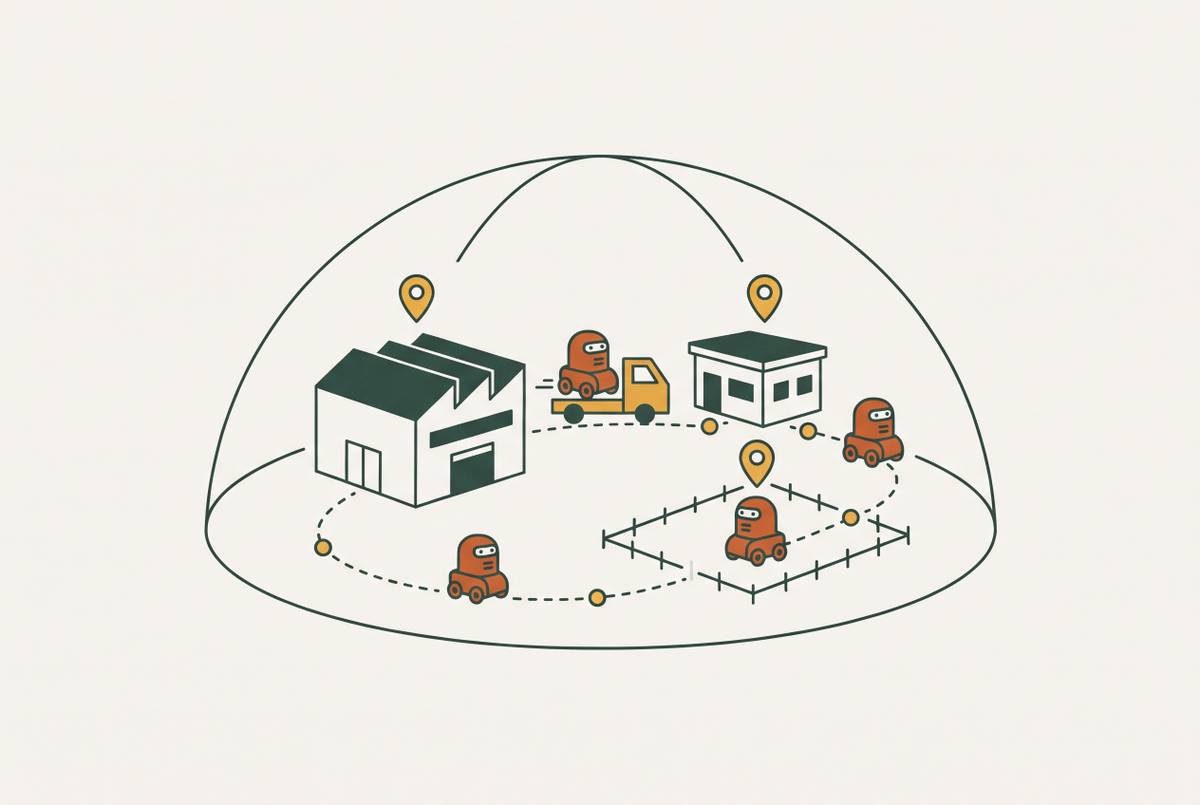
Scheduling Autonomous Mobile Robots Across Warehouses and Client Sites Under One Inland Marine Program
One inland marine policy can follow robot fleets across multiple sites under unified coverage terms.
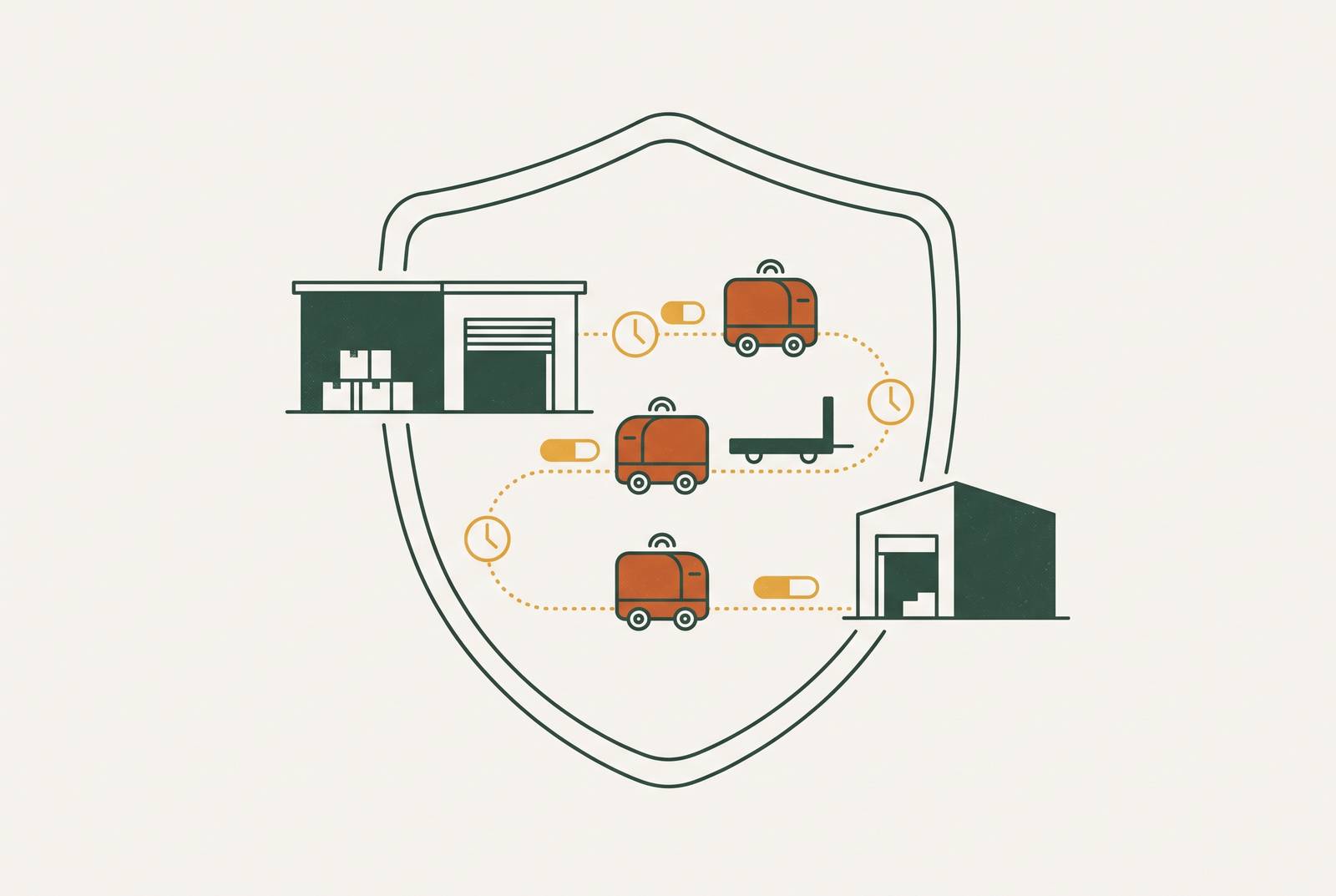
Inland marine coverage for deployed robot fleets can protect hardware in transit, at warehouses, and at third-party client sites under one program, subject to its terms. It is the property anchor. To build a program that follows autonomous mobile robots from site to site, the submission must explain how site conditions change, how operational handoffs work, and what software controls are in place before underwriters set coverage and price.
Why AMR fleets operating across multiple sites break standard property and liability coverage
A scheduler dispatches autonomous mobile robots between warehouses and client sites, where they work under different operating conditions and control arrangements. The same robot works with different floor layouts and patterns of contact with workers, and its software version and operating limits may change after the policy is written. Its risk does not stay at one address. Yet standard commercial property coverage is centered on owned or leased premises, with only a nominal off-premises sublimit potentially applying once equipment leaves that boundary.
A deployment introduces client operators, integrators, and facility owners who are not automatically insured under the operator’s commercial general liability policy, or CGL. Responsibility for an incident can extend from the manufacturer and software provider to sensor suppliers, maintenance contractors, and the systems integrator. Physical damage is only part of the exposure. Even when CGL covers that damage, it may leave production losses from a client’s line shutdown uncovered.
What insurance covers autonomous robots traveling between job sites?
Inland marine is property coverage for equipment that works beyond fixed premises. Its name comes from cargo insurance, but its modern purpose includes gear in transit, at jobsites, and temporarily away from the owner’s facility. That matches the movement of a deployed AMR fleet. A program can be structured around transport between warehouses, client deployments, pilots, and maintenance at third-party facilities, subject to the policy’s scope.
The key distinction is between following equipment and insuring an address. One inland marine policy can cover a fleet through a blanket or scheduled structure, with no need for a policy for each robot at each site. Blanket coverage places the robots under one limit without listing each unit, while a scheduled structure lists robots individually. Both need terms that fit the sites where the robots work. With either approach, coverage for each location or activity depends on the terms.
For an AMR business, this protects capital-intensive hardware that may spend nearly all its working life outside company walls. Injury to a warehouse worker, damage to a client’s equipment, and losses caused by failed automation require other coverage lines.
The full coverage stack a multi-site AMR program requires beyond the inland marine anchor
CGL addresses third-party bodily injury and property damage, including the exposure created when a robot operates near people or equipment at a client warehouse. It is the baseline in almost every commercial contract. Its role differs from inland marine because the loss belongs to someone other than the robot’s owner. Even then, responsibility may involve several parties that made, programmed, operated, owned, or oversaw the robot.
Technology errors and omissions coverage, or Tech E&O, covers wrongful acts and failures in how technology performs. An error in a robot control platform can cascade into equipment damage, defective output, or a facility-wide shutdown. That is not simply a broken-hardware claim. Tech E&O addresses gaps that property, CGL, and cyber coverage can leave around the performance of the automation service.
Cyber coverage addresses the networked side of fleet operations, including an attack that takes over robot controls and creates interruption or third-party claims across active sites. Workers’ compensation and employer’s liability address employee injury exposures arising from work around robots. Those claims can coexist with product liability claims against a manufacturer or integrator. One response does not eliminate the other.
An umbrella layer adds limits above primary coverage to meet larger contractual requirements, although its placement must match the underlying lines. D&O serves a different purpose within the business’s insurance program. It becomes a requirement at later funding stages, when some lead investors specify minimum limits or insurer ratings. These layers belong together because the business combines physical equipment, software services, human work, and investor obligations.
How the AI exclusion wave is eroding the CGL coverage AMR operators thought they had
CG 35 08 deserves particular attention in an AMR policy review. The ISO endorsement applies to bodily injury and property damage that arise from generative artificial intelligence under Products/Completed Operations coverage. Its scope is specific, not universal. It can remove protection where a deployment’s use of generative AI falls within the wording.
Two related forms address other parts of CGL. CG 40 47 excludes bodily injury, property damage, and personal and advertising injury arising from generative AI outputs, recommendations, and decisions across Coverage A and B. CG 40 48 concerns Coverage B only, excluding personal and advertising injury arising from generative AI-generated content, including intellectual property infringement, defamation, and privacy claims. The distinction changes which exposure is being removed. A review that treats the forms as interchangeable misses their different reach.
ISO forms underpin the vast majority of U.S. property and casualty policies, making adoption across the market consequential for operators and their clients. A facility manager, subcontractor, or public-sector owner may assume its standard CGL still protects an AMR deployment without knowing that an exclusion is attached. Cyber coverage has a related limit: AI-loss sublimits cap what it pays for those losses. Coverage can no longer be inferred from silence. The task is to identify the actual endorsement, compare its definitions with the deployed technology, and establish what protection remains.
How underwriters evaluate a multi-site AMR fleet when they agree to cover it
A specialist underwriter first needs to understand how much the operating environment varies across the fleet. Relevant conditions include floor surfaces, worker density, ceiling height, aisle width, and shift patterns. The home warehouse is not a sufficient proxy. A fleet program must account for the range of sites at which the same equipment will operate, because each setting changes the exposure.
Underwriters also need to establish who controls the robot at each stage. The scheduling platform, the client’s warehouse management system, a local operator, or a remote fleet manager may be in control. Handoffs concentrate questions about responsibility. Underwriters therefore need the control arrangements and handoff protocols.
Software risk makes documented safeguards central to that assessment. Telemetry, safe-stop systems, automated intervention mechanisms, and audit logs provide evidence of the controls in place when an autonomous system causes physical damage. Whether an alert was generated, reviewed, or overridden, and whether that override was documented, becomes relevant to reconstructing the decision. Witness accounts alone cannot establish those controls. Underwriters need evidence of bounded operation.
A fleet also creates accumulation risk when one platform flaw can affect every site running it. Underwriters must evaluate correlated exposure across the operating footprint as well as individual incidents. API access to performance, utilization, and operating domain data can help compensate for limited historical claims data and support a more informed assessment than a static submission.
Why submission quality determines whether a multi-site AMR program gets the coverage and price it deserves
For the operator, the practical task is to turn those underwriting questions into a documented account of the fleet. A generic application gives little basis for evaluating location variability, operational handoffs, or software controls. Uncertainty invites conservative terms. Higher premiums, broader exclusions, or a declination can follow when the submission leaves the underwriter to price an undefined exposure.
A specialist submission describes the operating envelope through site ranges, scheduling logic, handoff protocols, safe-stop architecture, telemetry, and human oversight. Continuous tracking and records of automated intervention give underwriters evidence they can use to assess the risk. Documentation supports coverage and pricing that reflect the actual operation, without promising a particular premium or response to a future loss.
The technical account also supports endorsement negotiations. A submission that distinguishes deterministic scheduling controls from the generative AI definitions in an applicable exclusion gives the broker a basis for challenging inappropriate wording. Labels alone are not enough to do that. The distinction must rest on how the platform operates, and the negotiated policy terms ultimately decide the coverage.
Contract provisions belong in this work before binding as well. Additional insured endorsements, waivers of subrogation, primary and non-contributory wording, and certificates of insurance cannot be left to an assumption that adequate limits will satisfy every client. Limits do not repair missing contractual provisions.
What enterprise and government contracts actually demand from an AMR operator’s insurance program
When a non-compliant insurance certificate keeps a robot out of a client site, the delay in paperwork also puts revenue at risk. Enterprise and government customers require insurance compliance before deployment. The program must meet the contract’s coverage and documentation requirements as well as protect the operator’s own assets.
Enterprise customers scrutinize cyber liability and Tech E&O in advanced technology deployments, while also specifying limits and contractual endorsements. Requirements generally increase from smaller customers through mid-market and enterprise accounts, and minimum limits have been rising. Earlier limits may no longer be sufficient. The relevant benchmark is the deployment contract, including its additional insured, waiver of subrogation, and primary and non-contributory requirements.
On public-entity projects, the generative AI exclusion needs a prompt review because owners and agencies may assume a standard ISO CGL policy gives them broad protection. Where a deployment incorporates generative AI, an endorsement can undermine that assumption. A certificate does not resolve the underlying wording. The multi-site structure must also meet additional insured requirements at each client site without leaving gaps, and this must be settled at placement before a later contract review.
Umbrella coverage usually adds the limits that enterprise contracts require. Its structure deserves the same attention as the primary placement. The underlying lines and follow-form provisions must support the required protection.
How to approach building a single inland marine program that holds across the fleet’s full operating footprint
Map the fleet before preparing the submission. That inventory should describe the types of sites, how scheduling and handoffs work, how software versions are managed, and what safety controls are on record. It supplies the underwriting evidence already identified.
A blanket structure usually gives a growing fleet more freedom to move among many locations, while a scheduled program lists each robot. Pricing still influences the choice. The operator and broker should compare how specialist underwriters price the two approaches against the fleet’s deployment needs and the proposed terms.
Every coverage layer then needs review for exclusions and gaps, with CG 35 08 specifically identified and negotiated where relevant. Additional insured coverage, waivers of subrogation, and primary and non-contributory provisions should be settled at placement. Retrofitting can be expensive or sometimes impossible without mid-term underwriting review. Software documentation should also explain how updates are tested, staged, and rolled back, since change management remains an underwriting variable after deployment begins.
The final safeguard is a specialist broker who reads every policy before it binds. That review must check how equipment coverage, liability wording, software exclusions, and the duties set out in contracts fit together across policies. The program depends on those connections holding. A specialist’s pre-bind review is what catches an endorsement, a gap between layers, or a contract requirement that a generic placement misses.