Recall Sublimits and Waiting Periods in Tech Company Policies
Sublimits and waiting periods can reduce your actual coverage far below the stated policy limit.
A tech company’s recovery after a recall or system failure depends on more than its headline insurance limit. Embedded sublimits, waiting periods, and retentions determine which losses qualify and how much the policy can pay. Understanding those restrictions before binding is essential, but reading alone is not enough. The coverage must also be negotiated around how the company’s systems actually fail.
Why the headline limit on a tech company's policy is not the coverage limit
A founder sees an aggregate limit when binding coverage, but the claim check may reflect a much smaller cap assigned to the particular loss. The declarations page does not explain that gap. A separate sublimit schedule can restrict the categories of expense that dominate a recall or system failure, while retentions leave part of the loss with the company. Defense costs may also use up the aggregate before the insurer pays the company for the underlying claim.
One policy might have a low retention and a $1 million social-engineering sublimit, while another has a higher retention, a much smaller sublimit, and defense costs inside the aggregate. For recall and system-failure exposure, the useful comparison connects the coverage trigger to the retention, sublimit, aggregate, waiting period, and treatment of defense costs. Each provision governs a different step between a loss occurring and an insurer paying it.
How sublimits work as embedded caps, not additions to coverage
IRMI defines a sublimit as a limitation on coverage for a specific type of loss that “is part of, rather than in addition to, the limit that would otherwise apply to the loss.” A payment for a loss in a sublimited category uses up part of the overall limit that applies, and the payment must stay within that category’s smaller cap.
Notification, transportation, and crisis management may each have separate sublimits within the recall structure. A company can hit several of those expense caps in one incident while still having some of its overall recall limit left. How much the policy covers for each expense matters as much as the total amount of coverage bought.
Hardware and autonomous-system companies face caps like these outside recall coverage, too. Hardware bricking or replacement, dependent business interruption, and system failure not caused by a malicious attack are categories in which sublimits commonly appear. Regulatory fines and penalties and reputational loss can also have separate caps. These are different parts of the same operational exposure. A recall that takes equipment out of service may lead to expenses and financial losses that fall under several separate limits.
Waiting periods as a second, time-based deductible that erases short-outage claims
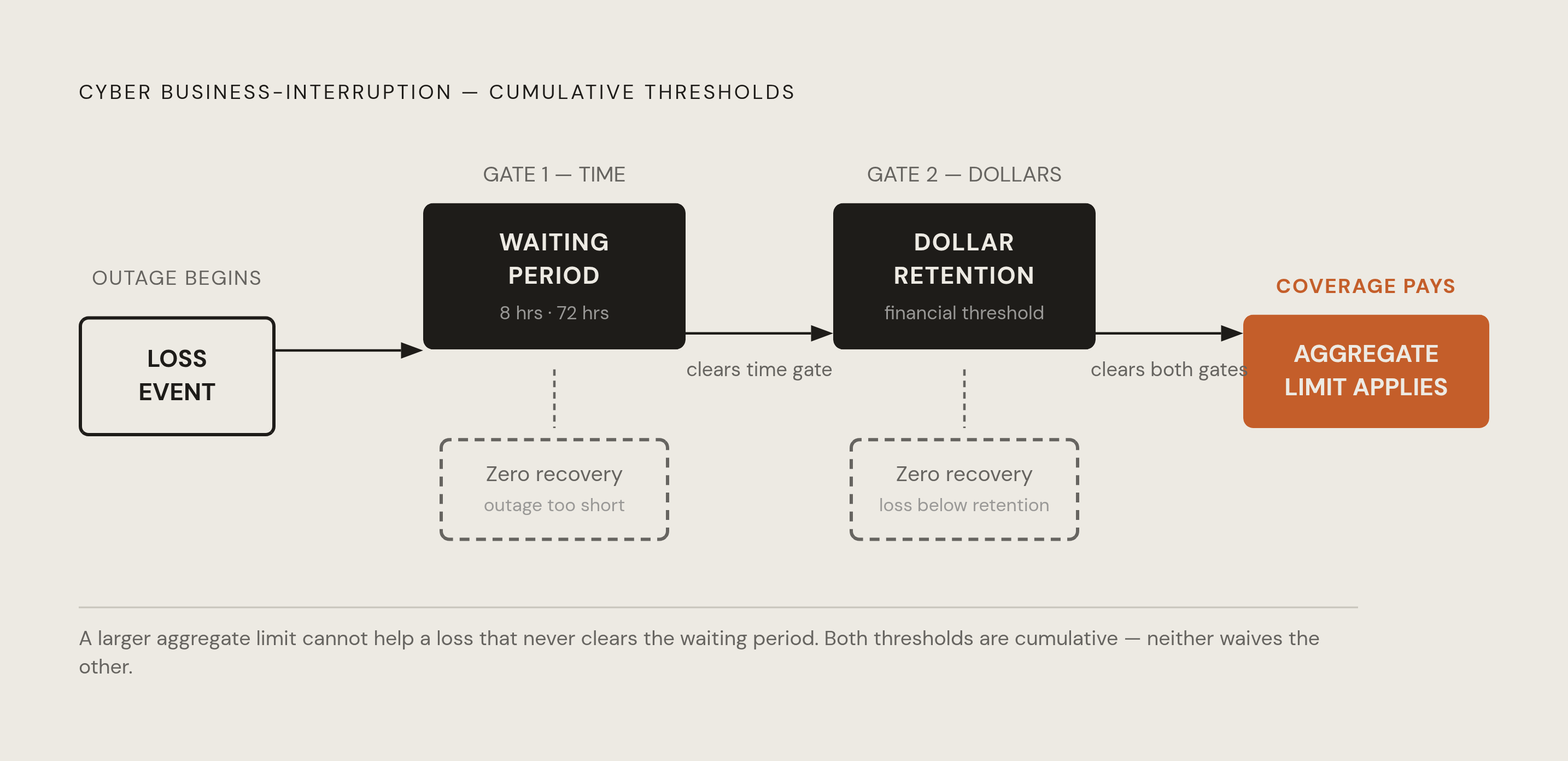
Cyber business-interruption coverage usually pays for time-element loss only after a set number of hours has passed. Losses inside that interval remain with the company. The dollar retention is separate, so exceeding the waiting period does not remove the financial threshold that the policy also requires the company to absorb.
The two thresholds are cumulative, not alternatives. A company must clear both before coverage responds, and a larger aggregate does not compensate for an outage that ends within the waiting period. An 8-hour waiting period and a 72-hour waiting period offer very different protection to a company that earns revenue around the clock. The effective cost of the interval depends on revenue lost per hour.
A software update can take a system offline for a weekend, while a sensor recall can pull units from service for days. A regulatory safety hold can also interrupt operations. To the extent those losses fall within a 72-hour waiting period, they produce no recovery under the interruption coverage. Robotaxi fleets, field-deployed logistics systems, and continuous-uptime industrial robots therefore face a time-based restriction that the advertised dollar limit does not reveal.
How autonomous-hardware failures specifically trigger sublimits across multiple coverage lines at once
An autonomous-system failure can implicate general liability, tech E&O, cyber, and product recall at the same time. Physical damage raises a general liability question, while an algorithmic decision raises a tech E&O question. A software update that introduced the fault may also implicate cyber coverage, and removing units from service raises recall exposure. These can be different consequences of one failure, divided among policies with their own restrictions.
Policy lines built around separate causes must address an event in which software behavior, physical harm, and withdrawal from service are connected. Each part can encounter its own sublimit. Financial losses also face a separate gap because product liability coverage may respond to bodily injury and property damage from AI-enabled robots or autonomous vehicles in some jurisdictions without covering the financial losses from the same failure.
Renewal changes can further narrow the available response. The market is moving away from “silent AI” coverage as carriers introduce AI-specific exclusions and revised forms. ISO forms CG 40 47 and CG 40 48, effective in January 2026, illustrate the distinction. CG 40 47 excludes bodily injury, property damage, and personal and advertising injury, including IP claims, arising from generative AI under Coverage A and Coverage B. CG 40 48 excludes only personal and advertising injury under Coverage B, so bodily injury and property damage are still covered under Coverage A. The forms are not interchangeable, and their generative-AI scope must not be confused with a blanket description of every autonomous-system failure.
What courts are finding when carriers try to confine claims to sublimited buckets
A documented 2026 federal court case turned on whether a ransomware sublimit endorsement applied to the Cyber Extortion insuring agreement. The carrier argued that its maximum payment for a malware claim was far below the amount promised for cyber extortion. The court agreed with the policyholder that the endorsement did not apply on its face to that insuring agreement. The wording defeated the carrier’s proposed restriction.
For an autonomous-hardware company, the analogous dispute would concern whether a software-induced recall belongs under a system-failure sublimit rather than a recall or business-interruption insuring agreement. That is a possible dispute, not a reported outcome in the cited case. Its relevance is the classification mechanism. A carrier’s description of the cause does not resolve which limit applies unless the policy language supports that treatment.
International International Control Services, Inc. had its entire $1 million Travelers cyber policy rescinded after a ransomware attack because its MFA deployment did not match its application representation. Coverage was void from inception. Application answers become the record an insurer examines after a claim, and a misrepresentation about a core control can support rescission as an increase in the risk of loss. Both disputes point back to the placement documents, because the language governing coverage categories and the representations supporting the contract are established before the loss.
What to read in a policy before binding, specifically for recall and system-failure exposure
The practical response is to review the policy by loss mechanism before binding. For every first-party and third-party coverage, map the trigger, retention or deductible, sublimit, and applicable aggregate. Read the endorsements against the insuring agreements they modify. For recall coverage, identify the separate caps for notification, transportation, and crisis management alongside the overall recall aggregate. This connects each expected expense to the provision that can restrict its payment.
For interruption coverage, confirm the waiting period in hours and whether it applies per event or per day. Then check how much revenue the company could lose per hour during that time. An outage scenario must account for both thresholds. The review should distinguish the losses absorbed during the waiting period from the dollar retention that remains applicable, rather than treating either provision as a substitute for the other.
Retention wording needs the same event-level scrutiny. Check whether it applies per event, per claim, per coverage, or per affected entity, and whether related-claims language aggregates the consequences of one failure. Incident response, business interruption, data restoration, notification, and regulatory proceedings may otherwise trigger multiple retentions. Confirm whether they sit inside or outside the aggregate, because legal defense can consume available limits before indemnity is paid.
For AI exposure, check for CG 40 47, CG 40 48, or equivalent exclusions, as well as endorsements assigning AI-related claims a separate lower limit. Examine the reach of “arising out of” language, which may encompass claims in which AI contributed to the loss without being its sole cause. Those provisions need to be compared again at renewal. Carriers can change sublimits, waiting periods, and exclusions while keeping the premium or aggregate much the same, so the same headline terms can come with different coverage. This review calls for specialist placement judgment.
Why generic submissions produce policies that are worst-suited to the companies most exposed to sublimit shortfalls
A standard commercial application has no fields for sensor failure modes, software update cadence, fleet-wide recall exposure, or the liability split produced by an autonomous-system failure. Those omissions leave the underwriter without the operating detail needed to distinguish the risk. An underwriter who does not understand the operation may price it conservatively and impose corresponding sublimits. The company with the most interconnected exposure can thus receive coverage built around assumptions that fit it poorly.
A submission built for the operation gives the underwriter a different basis for assessing that exposure. Its descriptions of monitoring, updating, and recall procedures must also be accurate, because operational representations can become relevant when a claim arrives. If deployment is only partial, describing it as universal puts coverage at risk. The same principle applies to cyber controls, where a control that lapses after binding or differs from the application can shift the claim into dispute. More detail is useful only when it faithfully describes the risk being insured.
Specialist placement connects that description to carriers prepared to insure the failure modes. Programs built for autonomous robots can cover failures in AI navigation or perception, physical damage when a cyberattack takes over robot controls, and production losses caused by software updates or sensor failures. Their relevance is the fit between operation and coverage. Such carriers are more likely to calibrate sublimits to those mechanisms than to default to caps intended for conventional hardware.
A licensed broker who has experience with autonomous-hardware placement can use that fit to push for changes to sublimits, waiting periods, and the scope of AI exclusions before binding. Negotiability gives the company a chance to resolve restrictions while the carrier is still deciding what to offer, before a loss has fixed the dispute around signed wording. The submission is therefore more than an application for a headline limit. It is the basis for negotiating whether the policy can respond to the company’s actual failure modes.